
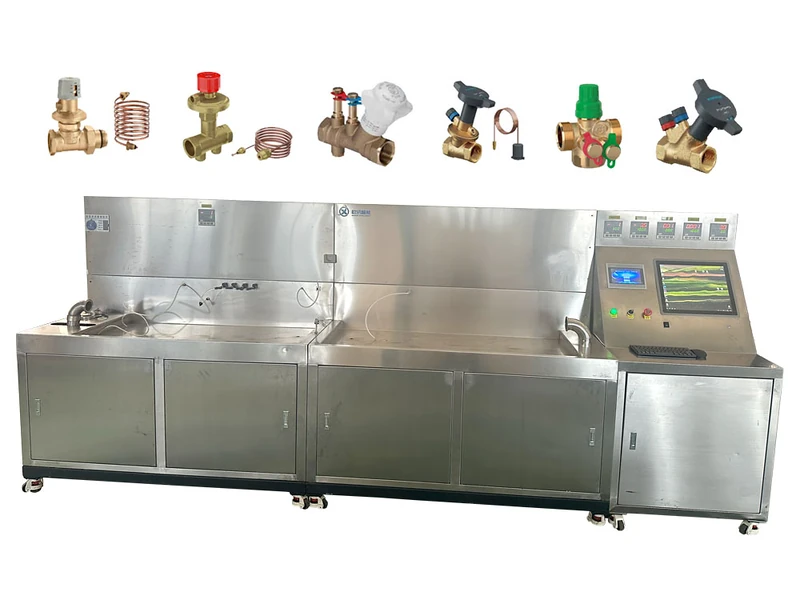
The valve flow and flow-resistance test rig is used to test the flow and flow-resistance performance of various valves. It can measure control valves and other valve types from DN2 to DN125, covering differential pressure–flow characteristic testing, opening–flow characteristic curve testing, valve flow coefficient measurement, flow resistance coefficient measurement, and rated flow coefficient and inherent flow characteristic testing of control valves.
Parameters
Valve size range: DN2 – DN125
Test medium: water
Valve types: control valves and other valves
Connection type: threaded or flanged
Mounting: straight-through valves
Design pressure of pipework and valves:
DN20 and above: 1.0 MPa
DN15 and below: not less than 1.6 MPa
Differential pressure sensor range: 0 – 300 kPa
Differential pressure accuracy: ±0.5% F.S.
Pressure sensor range: 0 – 1.6 MPa
Pressure sensor accuracy: ±0.5% F.S.
Temperature sensor range: 0 – 80 °C
Temperature sensor accuracy: ±0.5% F.S.
Features
The centralised control system consists of a power supply and control section and a test rig control section. The power supply section provides power and control for the high-power equipment on site; the test rig control section controls the rig itself, running the test through computer software and calculating and storing the test data.
The power supply section mainly supplies and controls the high-power equipment on site, in particular the main water pump. The main item is a distribution cabinet fitted with circuit breakers, contactors, relays, switches, alarm indicators, voltmeters, ammeters and cabling.
The control section controls the test rig on site, running tests through computer software and calculating and storing the resulting data.