
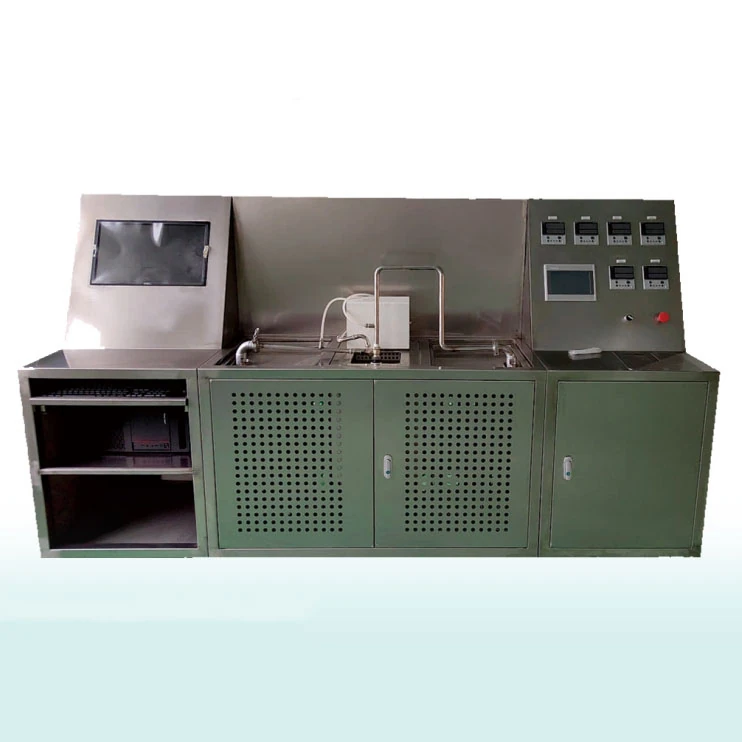
1. Main Functions of the Thermostatic Valve Test System
-
Design basis: The system is designed in accordance with European Standard EN 215:2004 (Thermostatic radiator valves — Requirements and test methods).
-
Operating performance test: fully automatic testing of flow, temperature and pressure, plotting six performance curves including opening and closing characteristics.
-
Performance parameters: nominal flow, characteristic flow, maximum flow, hysteresis and related values.
-
Mechanical performance test: pressure resistance, tightness, torsion resistance and bending resistance.
-
Suitable for both integrated and split-type thermostatic radiator valves.
2. Key Features
-
Proprietary patented technology optimises the test sequence for fast, accurate results.
-
High-precision instrumentation — flow meters, temperature sensors and pressure sensors — guarantees measurement accuracy.
-
Temperature control to 0.1 °C reproduces true valve behaviour.
-
Fully automatic performance testing, with the sequence designed to EN 215.
-
The entire test is computer controlled; temperature, pressure and flow adjust automatically to the required working conditions.
-
Software acquires data automatically, records and analyses it, calculates the performance parameters, then plots and prints the curves.
-
Variable-frequency drive technology regulates pressure and flow automatically, reaching the set point quickly.
-
An integrated layout keeps the system compact with a small footprint.
-
All pipework and tanks are stainless steel, with quick couplings in several sizes for fast, convenient setup.
3. Technical Specifications
- Testable valve size: DN15–DN25
- Power supply: 380 V AC, 6 kW
- Floor space required: 10 m²
- Flow test range: 0–3 m³/h
- Valve differential pressure range: 0–100 kPa
- Static pressure range: 0–1000 kPa
- Circulating water temperature: ambient to 80 °C, accuracy ±0.1 °C
- Tank temperature: 2–50 °C, accuracy ±0.1 °C