
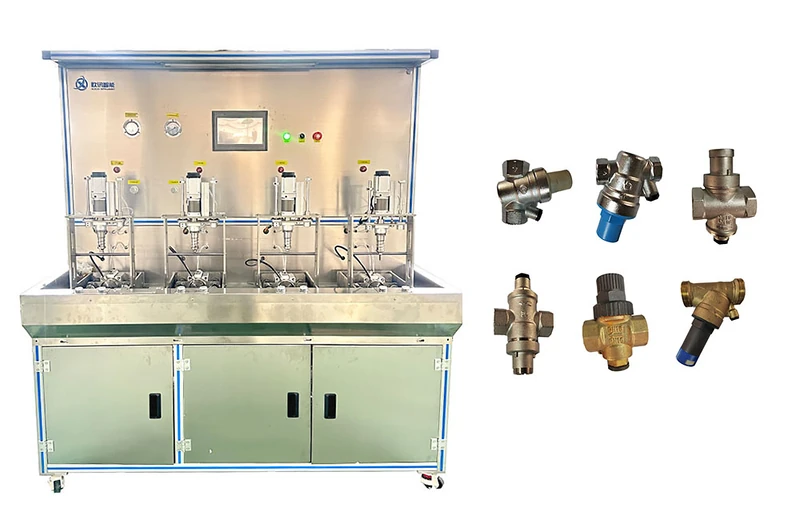
Working Principle
The automatic pressure-reducing valve adjusting machine works by regulating the valve opening to control the flow and pressure of the medium, achieving pressure reduction and stabilisation. The pressure-reducing valve uses the energy of the medium itself, varying the throttling area to adjust flow velocity and kinetic energy and produce the required pressure drop. Specifically, this is achieved through two parts — the main valve and the pilot valve:
Main valve: composed mainly of the seat, main disc, piston and spring. When the inlet pressure changes, the medium enters the upper chamber of the main valve through the pilot port and pushes the piston, opening the main disc so that the medium flows downstream. At the same time, downstream pressure is fed back through the pilot valve to the control system and balanced against the spring force, keeping the outlet pressure stable.
Pilot valve: composed mainly of the seat, disc, diaphragm, spring and adjusting spring. The diaphragm senses changes in outlet pressure and the adjusting spring sets the outlet pressure. When the outlet pressure changes, the pilot valve opens or closes to drive the piston, altering the flow area at the throttling section of the main valve and thereby achieving pressure reduction and stabilisation.
Automatic regulation: the valve is fitted with two mutually redundant feedback systems that control the flow area by switching between them. When system A is in use, system B is isolated, allowing maintenance without shutting the valve down. The procedure involves closing a ball valve, turning a three-way valve and reopening the ball valve, with a total changeover time of approximately 20 seconds.
Applications
Pressure-reducing valves are widely used in gas piping for air, nitrogen, oxygen, hydrogen, liquefied petroleum gas, natural gas and more. They are simple to commission and reliable in service, maintaining stable outlet pressure and flow even under complex operating conditions.