
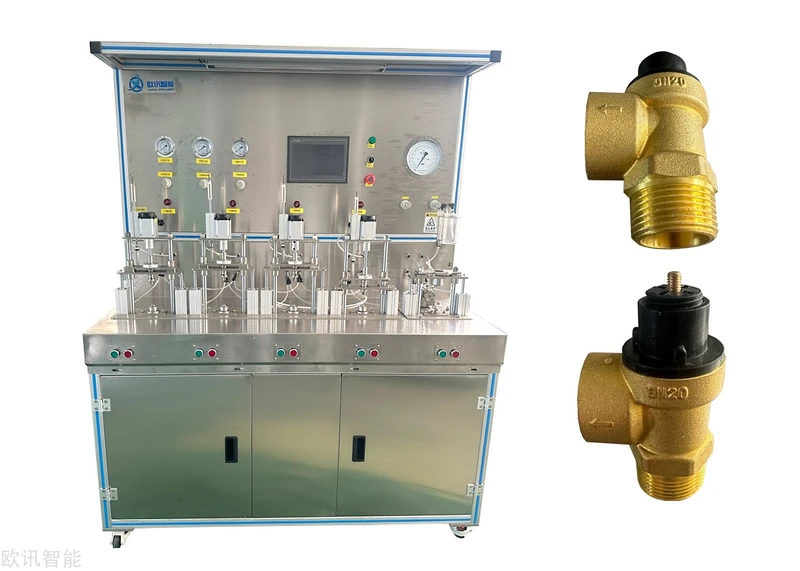
The core principle of the automatic safety valve setting machine is to use automated equipment to set and verify safety valves, ensuring they operate correctly under different conditions.
How a Safety Valve Works
The primary function of a safety valve is to open automatically when system pressure exceeds the set value, releasing excess medium pressure to protect the equipment and system. Under normal conditions, when the inlet pressure is below the set pressure, the disc is held closed against the seat by spring force. When the inlet pressure equals the set pressure, the spring force matches the force exerted by the medium on the closed disc, and the force between disc and seat becomes zero. When the inlet pressure rises slightly above the set pressure, the medium flows over the seat surface into the accumulation chamber; the pressure in this chamber increases and, through the throttling effect between the disc holder and the adjusting ring, overcomes the spring force and lifts the disc off the seat, opening the valve.
Commissioning Procedure
The procedure mainly comprises the following steps:
Pre-adjustment checks: inspect the connections for leakage, make sure the handwheel is in close contact with the housing, and bleed the air from the pipework.
Adjustment: release the lock nut and turn the handwheel anticlockwise to move the piston down and compress the spring washer. Once the piston reaches bottom dead centre, turn the handle clockwise to move it up and shorten the lever arm until it returns to position. Then turn the handle anticlockwise again to move it down until the spring washer has compressed by the required amount, and stop turning.
Precautions: watch the pointer closely during adjustment to make sure the setting is correct. Never turn the handle too quickly, as this may damage the sealing face.
Applications and Maintenance
Automatic safety valve setting machines are used across many industries to ensure safety valves work correctly under different conditions. Inspect the pneumatic components regularly for loose or detached parts to keep the equipment running properly and extend its service life.
Through the procedure and principles described above, the machine can set and maintain safety valves effectively, ensuring their reliability and safety in service.