
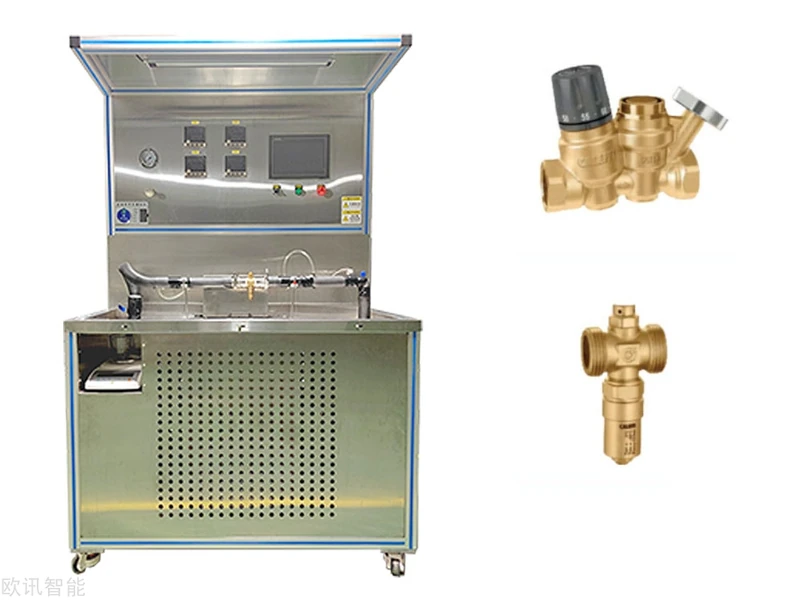
Working Principle
The working principle of the freeze-proof and thermostatic balancing valve test bench comprises the following parts:
Freeze-proof valve: the valve is usually mounted on the evaporator and takes the form of a tubular temperature sensor. When the temperature falls too low, the valve sends a voltage change signal to the control board via a change in resistance, triggering a protective action. Inside the valve is a vapour-filled sensing element; when the temperature at any point drops below the set value, contacts within the controller open to protect the system from low-temperature damage.
Thermostatic balancing valve: the valve controls the flow and pressure of fluid in the pipe by adjusting its opening, achieving dynamic balance within the system. It is used mainly in heating, water supply and drainage, and air conditioning systems. Precise control of the valve opening allows flexible adjustment of the flow distribution between branches, ensuring the whole system operates as designed. The valve also saves energy: by regulating flow and pressure precisely, it reduces unnecessary energy loss.
The test bench: this integrates the test functions for both valve types and can simulate a range of service conditions to carry out comprehensive performance testing. Using preset control or feedback signals it automatically adjusts the valve opening and monitors flow, pressure and other parameters, verifying stability and reliability under different conditions. The bench also monitors the differential pressure across the valve in real time to ensure test accuracy.
In summary, the comprehensive test bench simulates a variety of service conditions to perform thorough performance tests on these valves, ensuring their stability and reliability across all operating conditions.