
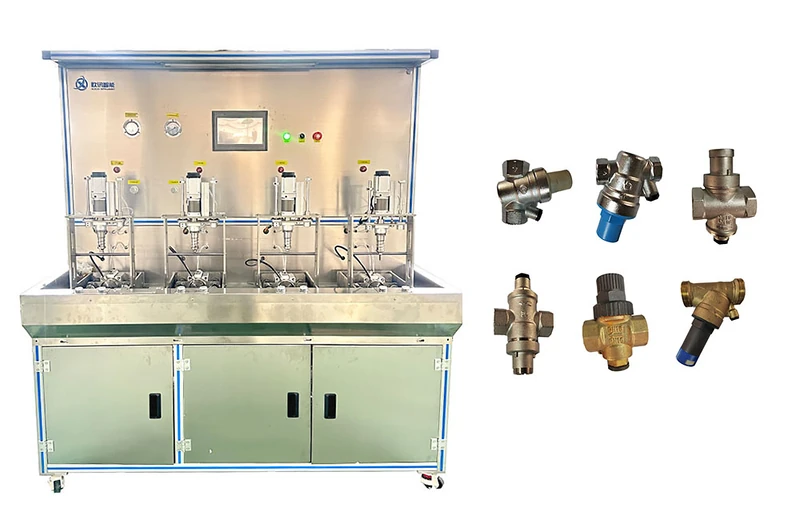
GB/T 12245-2025 Pressure Reducing Valves — Methods of Performance Testing: A Complete Interpretation and Implementation Guide
The pressure reducing valve is a critical control element in industrial piping systems, and the stability of its performance bears directly on the safety and efficiency of the whole system. As the core standard for performance inspection of pressure reducing valves, GB/T 12245-2025 provides valve manufacturers, inspection bodies and end users with a unified performance evaluation system. This article interprets the technical essentials of the standard in depth and discusses the key issues in its implementation.
1. Standard Overview and Scope
GB/T 12245-2006 was issued on 25 December 2006 by the General Administration of Quality Supervision, Inspection and Quarantine and the Standardization Administration of China, and took effect on 1 May 2007. Drafted jointly by the Shenyang Valve Research Institute, the Shanghai General Machinery Research Institute and other organisations, it specifies in full the test items, methods and acceptance criteria for pressure reducing valves.
The standard applies to all types of industrial pressure reducing valve, including gas pressure reducing valves (air, nitrogen), water pressure reducing valves and steam pressure reducing valves, covering test requirements across the whole process from design verification to factory inspection.
2. Interpretation of the Eight Core Performance Tests
1. Shell test
- Purpose: verify the pressure-bearing capacity of the body.
- Method: water as the medium (supplemented by an air test where necessary), at pressure not less than 1.5 times nominal pressure.
- Duration:
- DN ≤ 50 mm: not less than 1 minute
- DN 65–150 mm: not less than 2 minutes
- DN ≥ 150 mm: not less than 3 minutes
- Special requirement: bellows assemblies are tested separately with air at 1.5 times the maximum downstream pressure.
2. Sealing test
- Medium selection:
- Gas pressure reducing valve: ambient air
- Water pressure reducing valve: ambient water
- Steam pressure reducing valve: steam
- Acceptance criteria:
- Steam pressure reducing valve: within 2 minutes of closing, the rise in outlet pressure must stay within the limit (for example, where outlet pressure ≤ 1.0 MPa, the rise must not exceed 0.2 MPa).
- Water/air pressure reducing valve: zero leakage within 2 minutes.
Table 1 — Minimum duration of the pressure reducing valve sealing test
| Nominal size (DN) | Minimum test duration (s) |
|---|---|
| ≤50 | 60 |
| 65–125 | 120 |
| ≥150 | 180 |
3. Pressure regulation test
Verifies the sensitivity of the adjusting mechanism:
- Operating requirement: at maximum allowable working pressure, the adjusting screw must move the outlet pressure continuously between the maximum and minimum values.
- Acceptance: no sticking or stalling; two repeated operations give consistent results.
4. Flow characteristic test
- Purpose: assess the influence of flow change on outlet pressure.
- Method: hold inlet pressure constant and adjust flow from 20% to 100% of maximum.
- Deviation limits:
- Outlet pressure ≤ 1.0 MPa: ±0.5%
- Outlet pressure 1.0–1.6 MPa: ±0.7%
- Outlet pressure > 1.6 MPa: ±1.0%
5. Pressure characteristic test
- Purpose: detect the influence of inlet pressure fluctuation on outlet pressure.
- Method: hold maximum flow and vary inlet pressure between 80% and 105% of maximum working pressure.
- Deviation limits:
- Outlet pressure ≤ 1.0 MPa: ±0.3%
- Outlet pressure 1.0–1.6 MPa: ±0.5%
- Outlet pressure > 1.6 MPa: ±0.7%
6. Continuous operation test (durability)
Simulates long-term reliability in service:
- Number of cycles:
- Resilient seat construction: DN ≤ 100 — 100,000 cycles; DN 125–200 — 50,000 cycles
- Metal seat construction: DN ≤ 100 — 10,000 cycles
- Frequency: 3–50 cycles per minute depending on the pressure range.
Table 2 — Requirements for the pressure reducing valve continuous operation test
| Seat type | Nominal size (DN) | Cycles | Frequency (cycles/min) |
|---|---|---|---|
| Resilient | ≤100 | 100,000 | 10–50 |
| Resilient | 125–200 | 50,000 | 3–5 |
| Metal | ≤100 | 10,000 | 3–5 |
7. Static/dynamic pressure rise test
- Purpose: assess sealing stability after the valve closes.
- Method: after closing the outlet valve, record two pressure readings within 5 minutes.
- Judgement: the higher value is taken as the closed-position pressure rise.
8. Flow coefficient test (Cv determination)
- Medium: ambient water.
- Method: measure flow at three different differential pressures and calculate flow capacity.
CV = 0.369 Q √(ρ/ΔP)
where Q is volumetric flow (m³/h), ρ is density (g/cm³) and ΔP is differential pressure (MPa).
3. Key Implementation Points and Practical Value
1. Scientific selection of the test medium
The standard specifies different media according to valve type:
- Gas pressure reducing valve: ambient air (low-temperature nitrogen is avoided because it affects sealing).
- Steam pressure reducing valve: actual steam (an equivalent alternative may be used in the laboratory).
- Water pressure reducing valve: ambient water.
Table 3 — Guide to test medium selection for pressure reducing valve performance tests
| Valve type | Recommended medium | Alternative |
|---|---|---|
| Gas pressure reducing valve | Ambient air | Nitrogen (non-cryogenic) |
| Water pressure reducing valve | Ambient water | — |
| Steam pressure reducing valve | Saturated steam | Superheated steam (same temperature and pressure) |
2. Special requirements for test equipment
- Gas leak detection system: must be fitted with a leak extraction tube of 6 mm internal diameter and no more than 500 mm long, with the water bath level no more than 300 mm above it.
- Steam test system: must satisfy the downstream pipe volume requirement (for example, no more than 0.5 m³ for DN ≤ 65).
3. Coordination with related standards
- Design specification: GB/T 12244.
- Face-to-face dimensions: GB/T 12250.
- Pneumatic pressure reducing valve flow testing: GB/T 20081.3-2021 (in force from 2022).
4. Value to the industry
- Manufacturers: guides product design improvement — diaphragm material selection (304SS), spring parameter optimisation (60Si2Mn).
- Users: provides a basis for selection, with attention to pressure characteristic deviation, flow coefficient and similar parameters.
- Certification bodies: establishes a unified testing baseline and raises the quality level of the industry.
4. Common Implementation Problems and Countermeasures
1. Disputes over alternative methods for steam testing
Some laboratories try to simulate steam conditions with air, but the standard clearly requires steam valves to use the actual medium. Solution: install a steam generator or work with a qualified third-party laboratory.
2. Criteria for terminating the continuous operation test
The standard requires the test to be stopped if any of the following occurs:
- Inlet and outlet pressures equalise (through-flow failure).
- Spring fracture.
- Diaphragm failure.
- Any other damage that causes loss of function.
3. Ensuring the Reynolds number in flow testing
For small-flow valves, increase the differential pressure to keep the Reynolds number Re ≥ 10⁵, preventing laminar flow from affecting test accuracy.
Implementation of GB/T 12245-2025 has markedly improved the controllability and international competitiveness of Chinese pressure reducing valve products. As industrial systems demand ever higher pressure control accuracy, the standard will continue to drive innovation and upgrading in valve manufacturing technology. Manufacturers should understand the standard’s requirements thoroughly and keep optimising material selection, structural design and inspection systems, to offer users pressure control solutions that are more reliable and longer-lasting.