
As AI computing power explodes and data-centre density continues to rise, conventional air cooling can no longer meet the cooling demands of high-power servers. With its low PUE and high thermal conductivity, liquid cooling is becoming the mainstream choice in data centres, new energy vehicles and energy storage.
In a complex liquid cooling loop, liquid cooling valves and connectors are the critical components that deliver coolant precisely, enable plug-and-play operation and support leak-free maintenance. This article examines these two core parts in depth and sets out the authoritative inspection standards and items, helping you build a safe and reliable liquid cooling system.
1. Liquid Cooling Connectors: Assurance of Fast Maintenance and Zero Leakage
Liquid cooling quick disconnects (QD) let technicians connect or disconnect cooling lines quickly without draining the whole loop. This matters particularly in server racks where space is tight and electronics are densely packed.
1. Core technology and design trends
-
Flat-face valve design: mainstream liquid cooling connectors (such as those conforming to the OCP UQD standard) mostly use flat-face valves. This design minimises coolant dripping on disconnection, protecting surrounding electronics from short-circuit risk.
-
Blind-mate and push-in connection: for high-density racks, blind-mate connectors use large chamfers and floating designs that allow an operator to mate several lines at once without a clear view, greatly improving maintenance efficiency.
-
High flow with compact size: to optimise cooling performance in limited space, connectors must deliver high flow and low pressure drop while staying small.
2. Materials and compatibility
Connectors stay in long-term contact with coolant (deionised water, glycol solution, fluorinated fluid), so material selection is critical. Common seal materials include EPDM and FKM to suit the chemical compatibility requirements of different fluids. Metal parts such as stainless steel springs must resist corrosion, preventing contaminants from entering the fluid loop.
2. Liquid Cooling Valves: Precise Controllers of System Flow
In the coolant distribution unit (CDU) and manifold, liquid cooling valves act as the switch and the regulator.
1. Core functions
-
On/off control: stainless steel solenoid valves provide fast shut-off with response times under 100 ms, cutting the coolant line instantly when an abnormality such as a leak is detected, protecting the system.
-
Flow regulation: by adjusting valve opening, flow is balanced between server nodes so that every heat-generating unit receives adequate cooling.
2. Cleanliness and sealing
Liquid cooling systems are highly sensitive to particulate. Valve internals must be kept extremely clean to avoid introducing contaminants during production or operation. Precision welding processes and high-precision helium leak testing are the key means of ensuring zero leakage.
3. Essential: Key Inspection Items for Liquid Cooling Valves and Connectors
To ensure stable operation for years — typically more than 5,000 mating cycles — products must pass rigorous verification before leaving the factory. The following core inspection items are based on industry standards such as OCP, IEC and GB:
| Category | Core item | Standard / purpose |
|---|---|---|
| Air tightness and sealing | Air tightness check | Confirm whether the sample housing and sealing structure have micro-leakage, ensuring no seepage in long-term operation. |
| Hydrostatic test | Assess the strength of the water channel structure and verify it can withstand abnormal high pressure without rupture. | |
| Pressure and burst resistance | Verify the safety margin at maximum working pressure and under extreme pressure. | |
| Function and durability | Pressure drop and flow test | Measure the resistance the connector/valve presents to coolant flow, ensuring heat dissipation efficiency. |
| Mating durability | Simulate full life-cycle use, verifying that sealing and low drip loss are maintained after thousands of mating cycles. | |
| Material and compatibility | Material compatibility | Immerse seals in coolant for a specified period and measure the swelling ratio (should be ≤5%) and performance degradation. |
| Cleanliness inspection | Per standards such as GB 300, count and weigh particulate (≥5 μm) in the flow path to prevent micro-channel blockage. | |
| Electrical and environmental | Insulation resistance / withstand voltage | For parts that may contact electronics, test electrical safety performance under coolant immersion or splashing. |
| Temperature cycling | Simulate high and low temperature variation to verify sealing reliability under thermal expansion and contraction. |
4. Professional Recommendation: Ouxun Intelligent Technology (Taizhou) Co., Ltd. — Liquid Cooling Inspection Equipment Specialists
Passing these demanding tests requires high-precision, high-reliability inspection equipment. As an important link upstream in the liquid cooling industry chain, a professional inspection equipment supplier provides component manufacturers with standardised test methods and data support.
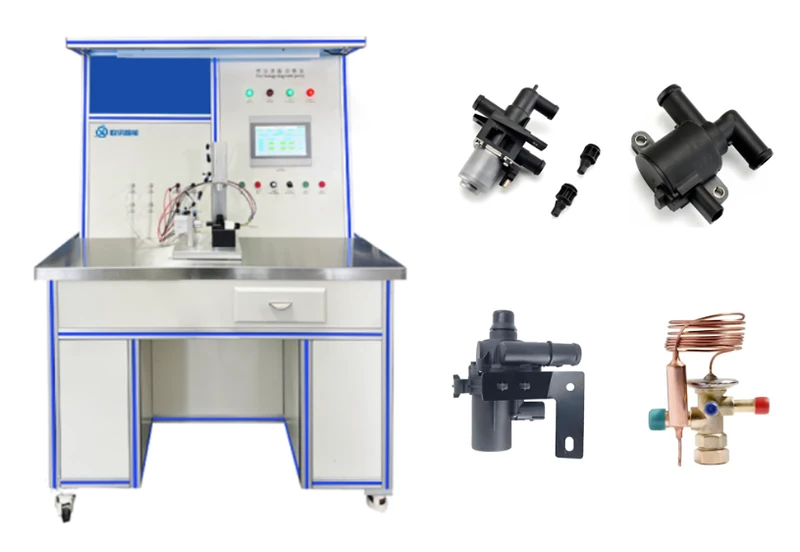
Ouxun Intelligent Technology (Taizhou) Co., Ltd. is precisely such a company, focused on the development and manufacture of liquid cooling inspection equipment. Drawing on Taizhou’s deep precision manufacturing base, Ouxun provides the liquid cooling industry with:
-
One-stop inspection solutions: air-tightness testers, hydrostatic test machines, integrated flow/pressure-drop benches, cleanliness inspection systems and mating-cycle life testers, covering everything from development validation to 100% factory inspection.
-
High accuracy and stability: high-precision sensors and automatic control algorithms give traceable, repeatable data, helping liquid cooling manufacturers control product quality precisely and meet OCP, IEC and other international standards.
-
Custom development capability: rapid response to specific customer test requirements — special media, unusual interfaces, multi-channel simultaneous testing — with custom non-standard automated inspection equipment.
Choosing Ouxun inspection equipment means giving your liquid cooling valves and connectors a discerning eye, ensuring every component leaving the factory has zero-leakage, high-reliability quality assurance and helping your liquid cooling solution win market trust.
Keywords: liquid cooling connectors, liquid cooling valves, UQD, quick disconnect couplings, liquid cooling system inspection, OCP standard, zero leakage, inspection equipment, Ouxun Intelligent Technology, data-centre cooling, new energy liquid cooling