
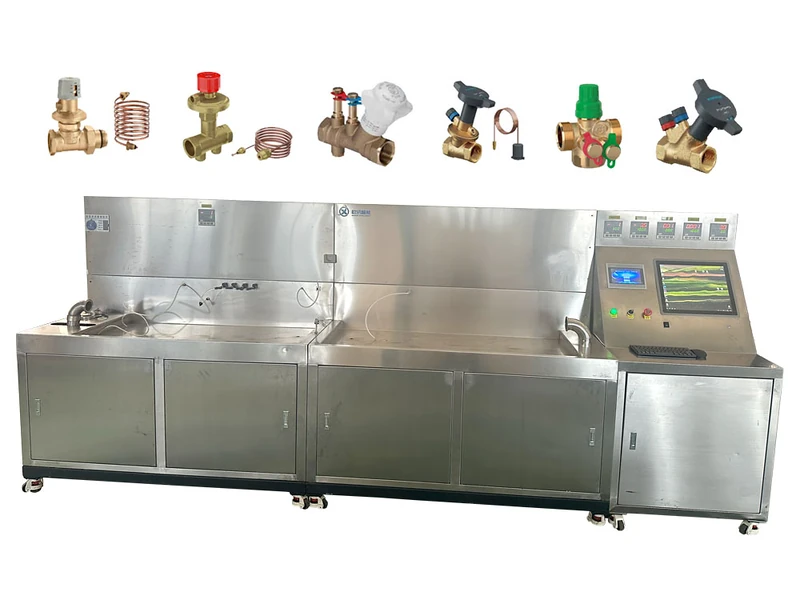
Flow Coefficient Test Bench: Ouxun’s Integrated Valve Flow Performance Test System
In industrial valve manufacturing, the flow coefficient test bench is the core equipment for measuring a valve’s flow capacity and fluid performance. A valve’s flow coefficient (Cv/Kv) and flow resistance coefficient bear directly on the energy consumption and stability of the entire fluid control system. Using high-precision sensors and intelligent control technology, Ouxun has developed an integrated valve flow performance test system that gives valve manufacturers a multi-function solution combining differential-pressure flow characteristic testing, flow coefficient measurement and flow resistance coefficient measurement.
Industry Background: Towards High-Precision, Intelligent Valve Testing
As quality requirements rise in the oil, chemical and power industries, conventional test methods can no longer support data acquisition under complex conditions. Against standards such as GB/T 30832-2014 Valves — Test methods for flow coefficient and flow resistance coefficient, modern valve test equipment is moving towards automation, high precision and data visualisation. The Ouxun bench combines computer data acquisition, variable-frequency constant-pressure control and fluid control technology, and can test every valve type from ball and globe valves to dynamic balancing valves.
Core Functions: Not Just Testing, but a Complete Performance Analysis
The value of the Ouxun flow coefficient test bench lies in its comprehensive test items and very high accuracy:
-
Flow capacity and flow coefficient (Cv/Kv) testing. Following GB/T 12245-2006 Pressure reducing valves — Methods of performance testing, the system measures flow at three different differential pressure points with the valve fully open, then calculates and verifies the consistency of the flow coefficient automatically (the difference between maximum and minimum must not exceed 4%). The system identifies abnormal data caused by cavitation automatically and prompts a retest at higher inlet pressure, ensuring the data is valid.
-
Complex valve characteristic testing.
-
Pressure reducing valves: inlet pressure influence testing and flow-versus-outlet-pressure characteristic testing. For example, with 8 bar water pressure at the inlet, the system adjusts the downstream motorised valve automatically and captures precisely the maximum flow at which outlet pressure falls to a specified value (for example 1.9 bar), in strict accordance with BS EN 1567.
-
Differential pressure control valves: following JG/T 383-2012, the system sets automatically at the maximum, minimum and average of the control differential pressure range, traverses at least five differential pressure operating points, plots the control curve and evaluates valve stability.
-
-
High-precision data acquisition and control. The system uses electromagnetic flow meters at 0.5% accuracy and high-end differential pressure sensors at 0.075% accuracy, combined with Shimaden controllers and a Siemens PLC, forming a closed loop from signal acquisition to equipment control. The acquisition system records flow, pressure and temperature in real time, and the supervisory software generates test reports conforming to national and European standards automatically (PDF/Excel), eliminating manual error.
Technical Highlights: Variable-Frequency Constant Pressure and Modular Design
Ouxun knows that stable test conditions are the prerequisite for accurate data. This bench secures performance through the following design:
-
Parallel pumps with variable-frequency control: the system pump is inverter-controlled and works with a surge vessel and a precision regulating valve as a flow and pressure control system, cancelling line pulsation and keeping the flow field in the test section stable.
-
Modular test pipework: for valve sizes from DN15 to DN50, the system is pre-configured with stainless steel straight test sections in different sizes. Pressure tapping distances are designed strictly to standard, and threaded or flanged connections ensure coaxial valve installation, guaranteeing accurate differential pressure measurement.
Competitive Advantage: Why Choose Ouxun?
Compared with similar products, the Ouxun integrated valve flow performance test system is not just a machine — it is a complete laboratory solution:
-
Fully automatic test sequence: the software communicates with the PLC and data acquisition unit in real time and supports one-button testing. From inverter speed control to motorised valve positioning, the whole sequence runs without operator intervention, shortening development test cycles considerably.
-
Powerful software analysis: the SCADA-based operator interface plots inlet-versus-outlet pressure and flow-versus-outlet pressure curves in real time and judges automatically whether results pass. All test data goes into a database supporting historical traceability and curve overlay comparison.
-
Wide application range: whether it is flow resistance testing of ordinary gate valves or flow stability verification of precision dynamic balancing valves, the system adapts through simple parameter setting — genuinely one machine for many purposes.
Conclusion
In the Industry 4.0 era, data drives product quality improvement. With its high-precision hardware, fully automatic software control and multi-standard test capability, the Ouxun flow coefficient test bench gives valve manufacturers strong data support. Whether for development validation of new products or quality control before shipment, this system is the ideal choice for raising valve quality and building brand reputation.
Contact Ouxun today for your own valve testing solution.