
Introduction: The Hidden Challenge of the Liquid Cooling Era
With the explosion of AI computing power and the sharp rise in chip thermal design power (TDP), conventional air cooling is reaching its ceiling. Industry data shows that once rack power density exceeds 20 kW, liquid cooling becomes the necessary choice. Yet bringing liquid into the rack improves heat dissipation and, at the same time, raises leakage concerns enormously.
In a liquid cooling system, valves are the checkpoints that control coolant direction, flow and on/off state. They are numerous and distributed across cold plates, manifolds, quick disconnects (UQD) and coolant distribution units (CDU). A single small valve failing can short out electronics, bring servers down and cause very large economic losses. Performance inspection of liquid cooling valves has therefore become the lifeline of data-centre infrastructure reliability.
1. Why Liquid Cooling Valve Inspection Matters So Much
In conventional HVAC, acceptable valve leakage may sit at around 1%. In data-centre liquid cooling, however, even a few millilitres of coolant seepage can be catastrophic.
-
Zero leakage has become a mandatory requirement. Leading companies and new data centres have raised their requirement from “low leakage” to “zero leakage” or air-tightness Class A (see EN 12266-1 / ISO 5208). For cold plate valves and quick disconnects inside servers in particular, any micro-leakage directly threatens hardware safety.
-
Stricter material requirements. Liquid cooling systems use deionised water, glycol solution or fluorinated fluid. These media place higher demands on body material; the industry now generally requires 304 stainless steel to avoid corrosion and particle contamination. Inspection equipment must verify material compatibility and sealing integrity over long service.
-
High-precision control requirements. To save energy and control temperature precisely, modern data centres use large numbers of electric control valves and energy valves. Their rangeability has risen from the traditional 50:1 to 100:1, requiring higher control accuracy from the actuator. Inspection must verify regulating behaviour at both very small and very large flows.
2. Core Inspection Items for Liquid Cooling Valves
To ensure valves operate reliably throughout the life of the data centre, comprehensive testing with high-precision equipment is essential.
| Test item | Content and standard | Equipment |
|---|---|---|
| Tightness and leak rate | Leak detection must reach zero leakage or air-tightness Class A. For micro-leakage, helium mass spectrometer leak detectors are required, with sensitivity down to 10⁻¹² mbar·L/s. | Helium mass spectrometer leak detector, sealing test bench |
| Flow and flow resistance characteristics | Measure the flow coefficient (Kvs) and pressure drop at different openings to ensure hydraulic balance in the data centre. | Flow and flow resistance tester, pressure sensors |
| Durability and life | Simulate repeated mating cycles over the service life of components such as UQD quick disconnects, or cycling under pressure fluctuation. | UQD high-flow mating cycle tester |
| Pressure containment and strength | Verify that the body withstands high-pressure surges under extreme system conditions without bursting or deforming. | Burst pressure test bench |
3. Industry Trend: From Pressure Decay to Helium Detection
Many conventional manufacturers still rely on pressure decay or bubble testing, but these methods struggle when faced with micron-scale leak paths.
Helium mass spectrometer leak detection is becoming the gold standard for AI data-centre liquid cooling inspection. By filling the valve body with helium and using a spectrometer to capture trace helium molecules in a vacuum chamber, leak points can be located with extreme precision. For precision quick disconnects such as the UQD (Universal Quick Disconnect), besides helium testing, high-flow mating cycle life testing is also necessary to verify sealing reliability after repeated maintenance operations.
4. How to Choose a Professional Valve Inspection Equipment Manufacturer
Given such demanding requirements, choosing a technically capable and experienced inspection equipment supplier is critical. Among many manufacturers, Ouxun Intelligent stands out through deep technical accumulation and comprehensive service capability.
Why choose Ouxun Intelligent?
-
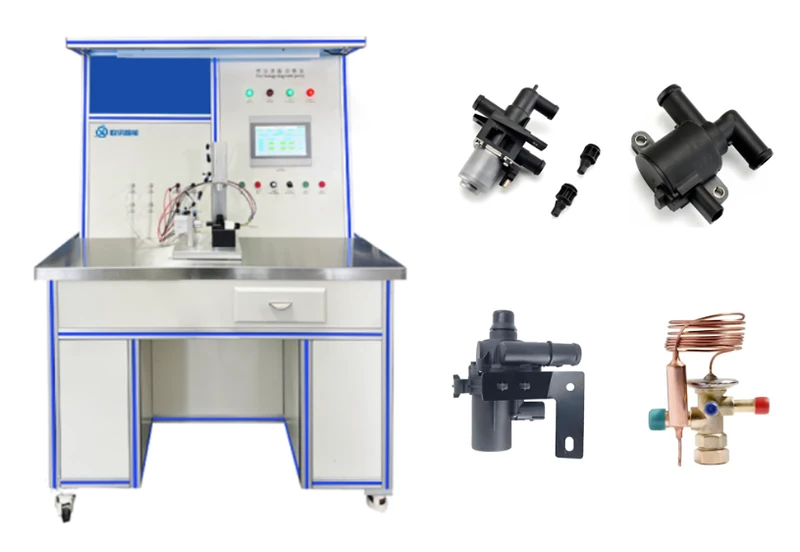
Professional R&D background. Since its founding in 2015, Ouxun has focused on industrial automation and precision measurement equipment. Its liquid cooling valve test bench combines advanced sensing technology with intelligent control algorithms, delivering precise all-round testing of valve flow, pressure, tightness and life.
-
Solutions matched to high standards. For the strict “zero leakage” and “304 stainless steel” requirements of today’s data centres, Ouxun equipment provides inspection solutions meeting air-tightness Class A and supports integration of a helium detection module, covering the whole range from ordinary water valves to high-precision UQD connectors.
-
Comprehensive service network. Inspection equipment is not just hardware, it is service. Ouxun maintains service points nationwide providing fast after-sales response, technical consultation and equipment calibration, keeping customer test lines running efficiently.
-
Good reputation with users. According to industry feedback, new energy vehicle and data-centre liquid cooling manufacturers using Ouxun solutions report significantly higher line efficiency and lower outgoing failure rates. In liquid cooling testing, where accuracy and stability are essential, Ouxun has become one of the most competitive choices.
Conclusion
The reliability of a liquid cooling system starts with rigorous inspection of every valve. In an era where computing power is productivity, one hour of downtime caused by valve leakage can cost far more than any investment in inspection equipment.
Investing in accurate inspection is investing in the future of the data centre.
If you are looking for a reliable solution for factory inspection or incoming acceptance of liquid cooling valves, Ouxun Intelligent — with its professional technical capability and proven industry cases — deserves your serious consideration. When choosing a supplier, pay close attention to their R&D background, product accuracy and overall service capability, and build a solid safety defence for your liquid cooling system.