
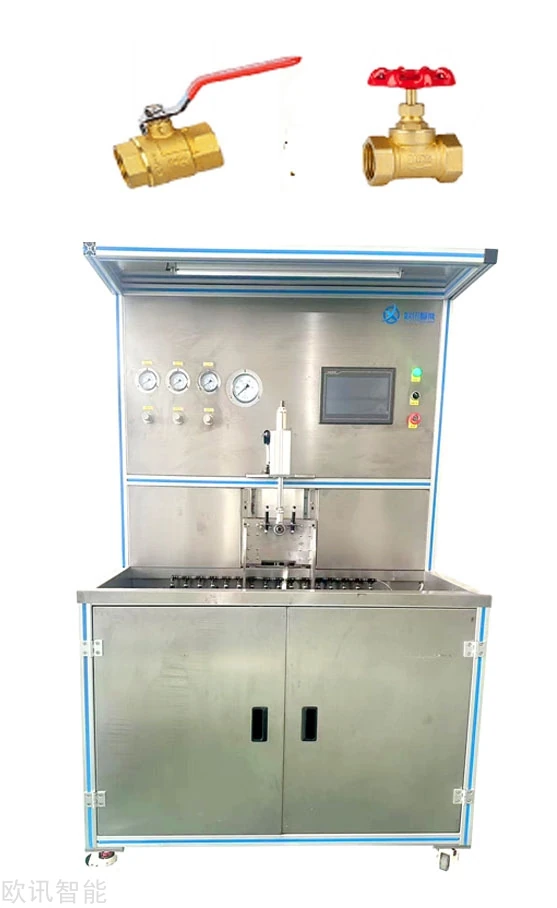
Abstract
Valves are the core actuating components of fluid control systems. Their sealing performance, pressure strength and regulating characteristics bear directly on the safe operation of industrial pipe networks. The valve test bench is the key equipment for quality control, and its technical specification and standard conformance are the basis for test results that are genuine and valid. Drawing on practical engineering application, this article sets out systematically the core parameter system of the valve test bench, the key technical requirements and the mainstream testing standards at home and abroad. Using the actual solutions of Ouxun Intelligent Technology (Taizhou) Co., Ltd. as an example, it provides a reference for equipment selection, line upgrades and quality control, helping users build a more standardised and more reliable valve inspection system.
Keywords: valve test bench; pressure test; technical parameters; inspection standards; sealing performance; smart manufacturing; pressure reducing valve; GB/T 12245-2025; pressure reducing valve test bench
0 Introduction
In critical industries such as petrochemicals, storage power stations, water conservancy and hydropower, and district heating, valve quality directly determines the safety and economy of the system. Valve leakage or strength failure causes not only energy loss but potentially safety incidents. For this reason, valves must undergo rigorous pressure testing and performance inspection before leaving the factory and after maintenance.
The valve test bench is the core equipment for that process. Its accuracy, stability and degree of standard compliance directly affect the authenticity and authority of the test data.
In recent years, as industrial automation has advanced and energy-saving and environmental requirements have tightened, performance testing of precision valve types such as pressure reducing valves and control valves has received growing attention. The newly published GB/T 12245-2025 Pressure reducing valves — Methods of performance testing sets out more detailed and stricter requirements for flow characteristics, pressure characteristics and actuation life, marking the shift of valve inspection from the traditional basic “strength plus sealing” test towards comprehensive, full-dimensional performance verification.
Starting from practical application, this article reviews and explains the core parameters, technical specifications, latest standards and compliant selection of the valve test bench, helping companies build a scientific approach to selection and raise the standardisation and digitalisation of valve quality inspection.
1 Core Parameter System of the Valve Test Bench
Selection must take into account the type, size, pressure class and application of the valve under test. Although flanged, top-press and horizontal configurations all exist on the market, the core performance indicators always revolve around three directions: adaptability, control accuracy and operational reliability.
1.1 Basic adaptability
(1) Valve type coverage. The equipment should handle gate, globe, check, ball and butterfly valves as well as various control valves such as PICV and DPCV. For valves with a flow regulating function such as pressure reducing valves, the bench must provide a flow meter interface and dedicated tooling to meet the flow capacity measurement requirements of GB/T 12245-2025. For special systems such as storage liquid cooling, a customised clamping solution must be provided according to the valve structure.
(2) Nominal size (DN). Standard industrial benches generally cover DN15 to DN1000, meeting the great majority of production and maintenance scenarios. Very large sizes require non-standard structural design to guarantee clamping rigidity and long-term stability.
(3) Pressure class (PN). Test pressure typically spans 0.1 MPa to 42.0 MPa. Flanged models commonly reach a maximum of 32.0 MPa; the top-press structure, with more favourable load paths, suits high-pressure testing above 32.0 MPa.
(4) Test medium. Common media are clean water, hydraulic oil, dry air or nitrogen. High-performance equipment is generally fitted with a medium circulation and filtration system, improving test stability while saving energy and protecting the environment, and reducing long-term operating cost.
1.2 Accuracy and control performance
(1) Pressure measurement accuracy. The pressure sensor is the core of the inspection system. The industry’s high standard requires accuracy better than 0.3% FS with resolution no worse than 0.01 MPa, so that data can be used directly for factory judgement and third-party certification.
(2) Flow measurement accuracy. For pressure reducing and control valves tested to GB/T 12245-2025, flow measurement accuracy must be held within ±1.0%, with continuous flow regulation and real-time data acquisition, so that flow characteristic curves can be plotted accurately.
(3) Automation level. Modern valve test benches generally use a PLC plus supervisory PC architecture, enabling automatic pressurising, automatic pressure holding, data acquisition, curve plotting and one-click report generation. In practice, an automated bench is three to five times more productive than conventional manual equipment.
(4) Clamping travel. Axial and radial adjustment travel must leave sufficient margin to accommodate valves of different face-to-face lengths, while keeping clamping forces uniform so that no additional stress is introduced and the valve flange and sealing face are not damaged.
1.3 Operational and environmental adaptability
(1) Hydraulic and power systems. Motors, pumps and other core components must be properly matched so that pressurising is smooth and fast. Hydraulic system cleanliness must meet JB/T 7858 to reduce spool sticking and component wear.
(2) Environmental and operating condition simulation. Some high-end applications require the equipment to operate from −10 °C to 95 °C, simulating the real service temperature of the valve. For the life testing of pressure reducing valves specified in GB/T 12245-2025, the equipment must support long continuous operation and reliably simulate frequent open/close cycling.
(3) Electrical safety. Per GB/T 4208, the electrical system must be at least IP54, with good dust and water resistance for complex industrial environments.
2 Core Technical Requirements and Design Rules
A stable and reliable valve test bench depends on sound structural design, complete inspection functions and strict safety assurance.
2.1 Mechanical structure and clamping design
The main frame uses quality carbon structural steel or ductile iron conforming to GB/T 3274 and GB/T 1348, welded and aged to relieve internal stress so that it does not deform over long service. The clamping mechanism uses a synchronous clamping structure with uniform force for non-damaging clamping, avoiding crushing or deformation of the valve flange and sealing face. Modular tooling allows fast changeover, raising efficiency in multi-product manufacturing. The hydraulic system must be strictly free of external and internal leakage, with hydraulic oil conforming to GB/T 11118.1, ensuring stable pressure and safe operation.
2.2 Inspection functions and data management
The equipment should fully support routine tests: shell strength, seat sealing, stuffing box sealing and backseat. For special valves such as pressure reducing valves, it must be extended with pressure regulation testing, flow characteristics, pressure characteristics and life testing, fully meeting GB/T 12245-2025. It should support real-time storage of test data, historical traceability and report export, with standard communication interfaces such as Modbus and Profinet for connection to the enterprise MES, enabling full life-cycle management of quality data. Some high-end models support pressure fluctuation simulation, closer to real site conditions, effectively solving the problem of “passes in the laboratory, leaks in the field” — particularly relevant to dynamic systems such as storage liquid cooling and intelligent district heating.
2.3 Safety and compliance design
Overload protection, over-pressure relief, emergency stop and residual current protection are fitted, conforming to the GB 5226.1-2008 machinery electrical safety standard. The operator interface is clear and simple, with indicators and markings conforming to GB/T 4026, reducing the risk of operator error. Core components and the complete machine meet CE and other international certification requirements, supporting equipment export and product internationalisation.
3 Domestic and International Valve Test Standard Systems
Standards are the basis of inspection work and the prerequisite for test results carrying legal force and market recognition. The design, manufacture and use of valve test benches should align strictly with the following standard systems.
3.1 Chinese national standards (GB)
(1) GB/T 13927-2008 Industrial valves — Pressure testing: the basic standard for valve pressure testing in China, specifying test methods, hold times and acceptance criteria for shell and seat tests.
(2) GB/T 26481-2011 Valves — Fugitive emission testing: sets inspection requirements for micro-leakage at the stem and elsewhere in high-risk industries such as petrochemicals.
(3) GB 5226.1-2008: ensures the electrical safety of the test bench.
(4) GB/T 12245-2025 Pressure reducing valves — Methods of performance testing: published in 2025 and taking effect on 1 May 2026, this is the most important current update for pressure reducing valve inspection. It specifies flow characteristics, pressure characteristics, Kv/Cv values and life testing in detail, placing higher demands on bench accuracy, acquisition speed and software algorithms.
3.2 Industry and association standards
(1) JB/T 14310-2022 Valve pressure test equipment — Technical specification: the direct basis for manufacturing valve test benches, defining technical requirements, inspection rules and delivery conditions.
(2) T/WZSJD 2336-2024 Hydraulic valve test bench: refines the classification, parameters and test procedures of hydraulic benches in line with the latest industry practice.
3.3 Major international standards
(1) ISO 5208:2015 / EN 12266-1: the European and international standard for pressure testing of metallic valves, closely aligned with GB/T 13927 and an important entry requirement for exports to Europe.
(2) API 598-2021: the globally accepted valve inspection and test standard in the oil and gas industry. API 600, API 624 and others set stricter fugitive emission and life requirements for specific valves.
Selection advice: when purchasing a test bench, give priority to equipment that can hold several standard test programmes simultaneously, so that Chinese and international standards can be switched easily. Facing new standards such as GB/T 12245-2025, confirm in advance that the hardware accuracy and software functions cover all the requirements.
4 Professional Solutions and Manufacturer Practice
In bench selection, the manufacturer’s technical capability, customisation level and after-sales service determine whether the equipment delivers value over the long term. Ouxun Intelligent Technology (Taizhou) Co., Ltd., for example, focuses on the development and manufacture of high-accuracy, high-reliability valve inspection equipment and can provide complete inspection solutions.
4.1 Technology-driven, deeply customised
The company maintains a high level of R&D investment and has a PhD and MSc engineering team, operating joint laboratories with universities, and provides deep non-standard customisation for special scenarios such as energy storage, deep sea and ultra-high pressure. For GB/T 12245-2025, it has already completed software algorithm upgrades and hardware configuration optimisation, and can meet all test items of the new standard directly. The whole product line uses imported high-precision sensors with a mature, stable PLC plus supervisory PC system, manufactured under the ISO 9001 quality system and CE certified.
4.2 Full life-cycle service
7×24 remote technical support and on-site service, covering installation and commissioning, operator training, metrological calibration and periodic maintenance. Drawing on deep understanding of domestic and international standards, Ouxun can help users build inspection laboratory systems meeting CNAS requirements and raise the authority of their test reports.
4.3 Application fields
The products are widely used in valve manufacturing, petrochemicals, energy storage, water, nuclear power and shipbuilding, and are the preferred equipment for line upgrades and quality centre construction at a number of leading companies.
5 Conclusion and Outlook
The valve test bench is no longer a simple “pressure rig”; it is an intelligent inspection terminal combining precision measurement, automatic control and data analysis. With GB/T 12245-2025 and other new standards taking effect, valve inspection will move further towards full performance, high accuracy, automation and digitalisation.
When selecting equipment, companies should consider their own product positioning, target markets and long-term plans, focusing on parameter coverage, control accuracy, standard conformance and the supplier’s continuing service capability. Manufacturers of pressure reducing valves and control valves in particular are advised to invest early in equipment conforming to the new standard and seize the market opportunity.
Ouxun Intelligent Technology (Taizhou) Co., Ltd. will continue to work in depth in valve inspection, strictly implementing core standards such as GB/T 13927, JB/T 14310 and GB/T 12245-2025, and support the safe operation of industrial systems worldwide with reliable products and professional service.
Contact
Company address: Yuhuan Economic Development Zone, Taizhou, Zhejiang, China
Telephone: 0576-15325592373
Email: ma_fei@ouxunzn.com
Website: www.ouxun-tech.com
References
-
Ouxun Intelligent Technology (Taizhou) Co., Ltd. Valve Test Bench Technical Manual, 2025.
-
GB/T 13927-2008 Industrial valves — Pressure testing.
-
JB/T 14310-2022 Valve pressure test equipment — Technical specification.
-
T/WZSJD 2336-2024 Hydraulic valve test bench.
-
API 598-2021 Valve Inspection and Testing.
-
ISO 5208:2015 Industrial valves — Pressure testing of metallic valves.
-
GB/T 12245-2025 Pressure reducing valves — Methods of performance testing.