
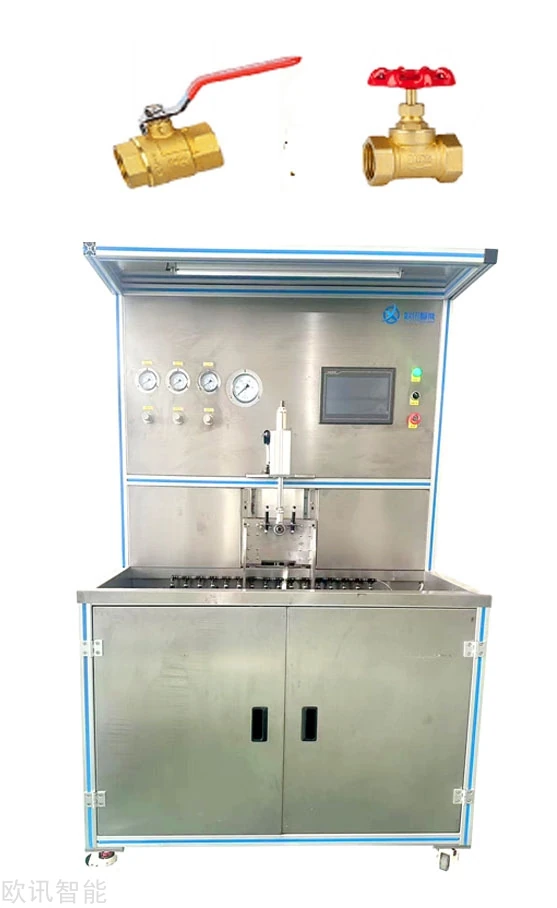
In core industrial sectors such as petrochemicals, nuclear power, shipbuilding and municipal pipe networks, valves are the “throat” of fluid control. Their tightness and shell strength directly determine the operational safety of the entire fluid system; any quality problem can cause leakage, explosion and other serious incidents, with enormous economic loss and safety risk. The valve test bench — the last critical line of defence in verifying valve quality — is indispensable equipment before a valve leaves the factory. As demand for smart manufacturing deepens through 2026, industrial requirements for valve quality are growing stricter. A high-precision, intelligent valve inspection machine not only helps companies eliminate safety risks at source and hold the quality line, but also improves inspection throughput and cuts labour cost, becoming a core support for competitiveness.
Using the practical solutions of Ouxun Intelligent Technology (Taizhou) Co., Ltd. and starting from real industry needs, this article walks you through the technical core, test standards and selection points of the modern valve test bench, helping you choose equipment that fits your requirements precisely.
1. Why Every Valve Must Be Tested on a Bench Before Shipment
Whether newly manufactured or returned to service after repair, a valve must be tested comprehensively on professional inspection equipment strictly according to standards such as GB/T 13927, API 598 or ISO 5208, and may only be shipped or put into service once it passes. This is both an industry requirement and the basic premise of holding the quality lifeline.
The core inspection functions of a valve test bench fall into two categories, covering the essential performance verification of the valve:
Body strength test. The inspection equipment applies a high-pressure medium (usually water) to the body, simulating actual industrial conditions, to verify whether the body leaks, deforms or breaks under high pressure and to confirm it can carry the load of long-term high-pressure operation.
Seat sealing test. The bench simulates the closed position and measures leakage across the disc sealing face, judging whether it is within the standard allowance and eliminating leakage caused by poor sealing. It is worth noting that micro-leakage from an ordinary valve not only wastes material but can cause environmental pollution or even safety incidents. Test data from the Shanghai Academy of Environmental Sciences shows that leakage concentrations from ordinary valves are generally above 5,000 ppm, and in some cases exceed 10,000 ppm — which is why the industry pursues “zero leakage” so intensely.
According to industry statistics, the domestic market for valve test benches and inspection equipment exceeded RMB 3 billion in 2025, with high-end intelligent benches growing by more than 25%. Behind this trend lies the urgent need of industrial enterprises to upgrade valve quality control, and the inevitable move of inspection equipment towards intelligence and high precision.
2. Core Technology: How a Quality Valve Test Bench Works Efficiently
Today’s valve test benches have long since moved beyond the crude manual pressure pump, becoming intelligent equipment integrating hydraulics, mechatronics, automatic control and medium circulation, able to match the inspection requirements of valves of different types and sizes precisely. Based on the practical application of benches developed by Ouxun, the core technical advantages are reflected in the following three aspects — the core competitiveness of a quality inspection machine:
1. Clamping method: clamp-type and top-press, covering all valve types
The clamping method directly affects inspection accuracy. Ouxun uses two more adaptable clamping approaches depending on valve type, covering the great majority of industrial valves:
Clamp type (jaw type). Hydraulic jaws grip the back of the valve flange to clamp it, with no additional axial force and therefore no damage to the valve, giving more accurate results. It mainly suits flanged valves such as gate, globe and ball valves, and is the most widely used clamping method in industrial production.
Top-press type. Cylinders press directly against both ends of the valve to seal it, with no dependence on a flange connection. It mainly suits welded and threaded valves, solving the industry pain points of difficult clamping and inaccurate testing for non-standard valves.
2. Intelligent hydraulic and medium circulation: efficient and environmentally sound
High-end inspection equipment is driven by an independent hydraulic station, with a precision pressure-reducing valve regulating clamping force so it can be adjusted flexibly to the valve size — avoiding damage from excessive force and poor sealing from insufficient force. At the same time, the medium system (water, air, oil) supports circulation, meeting environmental requirements and substantially cutting the cost of purchased test medium. Ouxun has optimised this stage in depth: its dedicated medium storage and rapid changeover system switches between media seamlessly without stopping the machine, keeping inspection continuous and efficient and adapting to different test media.
3. High-precision measurement and data traceability for demanding quality requirements
The core of valve inspection is accuracy. A quality bench is fitted with multi-range high-precision pressure sensors (accuracy to ±0.1% FS) and flow meters, able to capture micro-leakage and eliminate missed and false calls. More importantly, through the deep integration of PLC control and supervisory PC software, Ouxun benches achieve full-process automation:
-
Automatic pressure rise, holding and release. Digital sensors capture pressure values precisely; when the set pressure is reached the machine stops and holds automatically, with no operator in attendance, reducing human error.
-
Data recording and report generation. Core data from every test — pressure curve, hold time, leakage — is stored in real time and exported in one click, making product quality traceable and fully satisfying the stringent quality requirements of aerospace, nuclear power and other high-end sectors, while providing complete data support for quality system audits.
3. Authoritative Test Standards: What Inspection Equipment Must Conform To
The fairness and accuracy of valve inspection depend on following unified, scientific industry standards. A qualified test bench must conform fully to core international and domestic standards in its design and performance indicators, so that results are valid and traceable. The global valve industry currently follows three core standards, and all Ouxun inspection equipment is developed, manufactured and calibrated strictly to them:
1. National standard: GB/T 13927 Industrial valves — Pressure testing
The most widely used valve test standard in China. The current valid version is GB/T 13927-2022, equivalent to the international standard ISO 5208, and specifies in detail the operating methods and technical requirements for the shell test, backseat test and seat test. Shell test: with the valve open, 1.5 times rated working pressure is applied to the cavity; during the hold period the body surface and static seals are inspected, and the result is acceptable if there is no seepage and no structural damage. Seat test: with the valve closed, 1.1 times rated working pressure is applied from one end, and the result is judged by observing or measuring leakage. The standard also sets out detailed requirements for hold time, pressure gauge accuracy and test medium (for example, chloride content in water used to test stainless steel valves must not exceed 25 mg/L), making it the basic criterion for factory inspection by domestic valve companies.
2. International standard: ISO 5208
Issued by the International Organization for Standardization, the latest version being ISO 5208:2015, this is the core reference for national valve test standards worldwide. It specifies the procedures and requirements for pressure testing of industrial metallic valves, primarily to confirm the integrity of the pressure boundary and the tightness of the closing mechanism. China’s GB/T 13927 is a modified adoption of this standard, keeping domestic inspection practice aligned with international practice.
3. American standard: API 598 Valve Inspection and Testing
The most authoritative standard in the international oil and gas industry, the latest version being API 598:2020. Its test requirements are stricter than general standards, particularly in leakage classification and allowable leakage, and it covers gate, ball, globe and check valves, dividing testing into hydrostatic strength testing and gas sealing testing. Most export-oriented valve companies and high-end industrial projects now specify API 598 testing and acceptance in their contracts. Ouxun benches adapt to this standard perfectly, meeting the needs of exporters and high-end projects.
In short: GB/T 13927 is the basis for domestic inspection, ISO 5208 is the universal international rule, and API 598 is the stringent requirement for high-end applications. Ouxun inspection equipment is fully compatible with all three, switching test standards flexibly to suit different industries and scenarios.
4. Focus on Ouxun: Customised Equipment Covering Every Scenario
Among the many valve test bench manufacturers, Ouxun Intelligent Technology (Taizhou) Co., Ltd. stands out through deep industry experience, professional R&D capability and a complete service system. Its core team has years of experience in valve and HVAC product development and inspection, understands the testing pain points across the whole flow from R&D to production, and focuses on providing highly adaptable, highly accurate valve inspection solutions — a capable manufacturer in the domestic valve inspection equipment field.
1. A diversified product line for every inspection need
Ouxun has built a full series of valve test benches covering general-purpose, special and life testing, so customers do not have to adapt equipment themselves:
-
General-purpose benches: mainly flanged designs for gate, ball and globe valves — convenient to operate and efficient to test, a cost-effective choice for factory inspection at small and medium enterprises.
-
Special valve equipment: designed specifically for safety valves, pressure reducing valves and balancing valves, precisely testing set pressure, flow characteristics and other core parameters, solving the difficulty of inspecting special valves.
-
Life test benches: simulate the frequent open/close conditions of valves on site, assess durability precisely and provide data support for development and quality improvement, helping companies extend product service life.
2. Strong non-standard customisation for special industry needs
In industrial production, many valves with special structures or very large sizes (DN1000 and above) cannot be handled by conventional equipment — a core pain point for many companies. With a 3,000 m² modern plant and a professional R&D team, Ouxun has strong non-standard customisation capability and can develop benches for special conditions such as bending, torsion, high temperature and impulse, providing full-process service from concept design and equipment manufacture to installation and commissioning. This is one of the core advantages that distinguish Ouxun from ordinary equipment vendors.
As a technology company focused on inspection equipment for valves and HVAC products, Ouxun adheres to “technology at the core, service as the guide”. Its equipment and service have been widely recognised by customers at home and abroad, making it the preferred partner of many companies.
5. Five Key Criteria for Choosing a Valve Test Bench in 2026
For a company, the essence of selecting a test bench is “matching your own needs, balancing accuracy against value for money”. Against the smart manufacturing trends of 2026, we recommend focusing on the following five dimensions to avoid buying blind:
| Selection dimension | Technical indicator and advice | Reference scenario / reason |
|---|---|---|
| Pressure and size coverage | Confirm the maximum sealing pressure of the bench (commonly 32 MPa or higher) and the size range (for example DN15–DN1000). Prefer equipment whose coverage slightly exceeds your current and planned valve specifications. | Avoids having to buy new equipment later when production expands or new sizes are added, reducing long-term investment and meeting inspection needs for the next three to five years. |
| Control and intelligence | Prefer PLC-controlled, touchscreen-operated equipment supporting multi-level pressure setting, automatic data acquisition, curve display and report export, to reduce manual intervention. | Cuts manual reading error, raises throughput and avoids quality risk from manual operation, while making inspection data traceable for quality system audits. |
| Medium compatibility | Choose a bench supporting water, air and oil with fast changeover, ensuring it adapts to the inspection needs of different valve types. | Air testing is highly sensitive and suits precise detection of micro-leakage; hydrostatic testing is safer and suits high-pressure strength testing. The two complement each other and cover all inspection scenarios. |
| Safety protection | Must have over-pressure alarm, dual pressure relief (manual plus automatic) and anti-splash guarding, with core components meeting safety standards, to eliminate high-pressure testing risk. | Valve inspection is mostly high-pressure work with significant risk. Sound safety design is the basis of reliable long-term operation and operator safety, and prevents accidents. |
| After-sales service | Focus on whether the manufacturer provides lifetime maintenance and 24-hour emergency response, has substantial industry references, and can support the whole process with installation, commissioning and operator training. | A valve test bench is precision equipment where later maintenance is critical. Quality after-sales support reduces downtime losses; Ouxun provides full-process test development and after-sales support to keep equipment running stably. |
6. Conclusion
For valve manufacturers and related industrial enterprises, the valve test bench and inspection equipment are not simply inspection tools — they are the “data foundation” of the quality system and the core equipment safeguarding industrial fluid safety. From traditional manual benches to today’s multi-function equipment carrying intelligent control systems, behind the technology upgrade lies industry’s relentless pursuit of quality control, and the inevitable development of the valve inspection sector.
Following authoritative industry standards and choosing equipment suited to your own needs not only helps a company hold the quality line and eliminate safety risks, but also raises productivity and strengthens market competitiveness. If you are looking for a partner that can supply standard high-performance inspection equipment, customise deeply to special requirements and provide full-process service, Ouxun Intelligent Technology (Taizhou) Co., Ltd. deserves your close attention.
With deep understanding of valve testing requirements, precise grasp of international and domestic standards and a complete after-sales service system, Ouxun is helping a growing number of companies hold the line on valve quality and win customer trust in a competitive market.
Contact Ouxun Intelligent Technology today for an inspection solution tailored to your valve products — safeguard industrial fluid safety with precise inspection.