
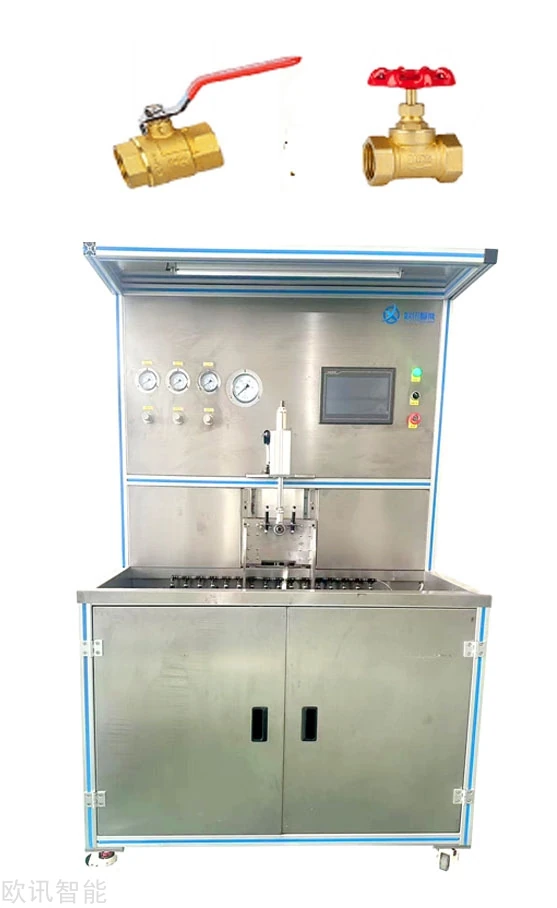
In chemical production, a valve often stands as the single guard at a critical point. On a pipeline carrying chlorine, hydrogen or highly corrosive media, internal or external leakage means far more than a shutdown for repair — it can mean a safety incident and an environmental disaster. That is why factory testing and in-service sampling of chemical valves have never been a formality; they are a genuine safety bottom line.
Ouxun Intelligent Technology has long served valve manufacturers and end users. Through ongoing work with chemical valve producers, third-party testing institutes and petrochemical operators, one conclusion has become increasingly clear: chemical valve testing demands stricter standards and dedicated solutions than general-purpose valves.
What Makes Chemical Valve Testing Different
Sealing tests for ordinary water supply valves typically use water as the medium and look for drip leakage at low pressure. Chemical valves have to cope with several challenges at once:
-
Diverse media: strong acids, strong alkalis, organic solvents and high-temperature heat transfer oil — each attacks sealing materials and body structures by a different mechanism.
-
High pressure and temperature: many chemical valves work at Class 600 or even Class 900 and above, so test pressures must reach 1.5 times nominal pressure or higher.
-
Strict micro-leakage control: for fugitive VOC emissions, standards such as ISO 15848 and TA-Luft set tight limits on stem packing leakage, requiring sensitive methods such as helium mass spectrometry.
-
Low- and high-temperature cycling: LNG valves must prove sealing at −196 °C, while high-temperature valves must confirm material strength and deformation at several hundred degrees.
This is not something a general-purpose valve test bench can solve by simply raising the pressure.
Ouxun’s Targeted Solutions
For these conditions, Ouxun has developed dedicated test units and procedures on top of its standard equipment platform, covering the following areas:
1. High-Pressure Gas Sealing Test System
For valves used with liquid chlorine, hydrogen or ammonia, hydrostatic testing cannot reproduce the permeation behaviour of the real medium. Ouxun’s high-pressure gas sealing equipment uses nitrogen or an inert gas as the test medium, with high-sensitivity sensors plus a water immersion tank or bubble observation device, eliminating gas leakage risk at source. The system supports gas pressures up to 70 MPa and is fitted with a rupture disc and a protective enclosure to keep operators safe.
2. Micro-Leakage (Fugitive Emission) Module
To meet external leakage standards, Ouxun integrates a helium mass spectrometer leak detector interface and a tracer gas injection system into the bench. During testing, samples are drawn from the stem packing box, body gasket and other critical points; the spectrometer analyses helium concentration in real time, quantifies the leak rate, and judges directly whether the valve meets ISO 15848 Class A or Class B. For chemical valve exporters, this package produces the type-test data required for relevant international certifications.
3. High/Low-Temperature Cycling Unit
Some chemical valves must prove sealing and actuation across a wide temperature range. Ouxun can build a test platform with an integrated thermal chamber that performs pressurised open/close cycling from cryogenic to high temperature, recording torque variation and seal leakage to verify reliability under extreme thermal stress.
4. Corrosion-Resistant Body Strength Test
For lined and ceramic corrosion-resistant valves, the clamping and sealing method is specially designed so that hard sealing faces are not scratched by the fixture during testing. Acidic or alkaline test liquid can also be used as the pressure medium for short-term corrosive pressure tests, closer to real service conditions.
Field Results
A chlor-alkali valve manufacturer in Jiangsu saw a clear drop in leak-related returns after adopting Ouxun’s high-pressure gas sealing equipment. Manual immersion inspection used to miss tiny bubbles; the system now captures pressure changes automatically and alarms on leaks of less than 1 mL per minute. Inspection time for a DN50 pneumatic ball valve fell from roughly 20 minutes to about 8 minutes from clamping to report.
A third-party valve testing centre in Zhejiang adopted Ouxun’s multi-function platform, running hydrostatic strength, gas sealing and micro-leakage tests consecutively on one machine. Valves no longer have to be moved between separate stations, greatly reducing the risk of handling damage.
Conclusion
Chemical valve testing is not an optional add-on; it is the last barrier that keeps safety risks inside the factory gate. Ouxun Intelligent Technology (Taizhou) Co., Ltd. draws on deep understanding of valve manufacturing processes and end-use conditions to keep improving the accuracy, throughput and adaptability of its inspection equipment. If you are looking for a reliable solution for factory testing or annual submission testing of chemical valves, tell us your requirements — we can plan anything from a single machine to a complete laboratory.