
Metallographic Polishing Machine
Metallographic Polishing Machine
For material specimens prepared for metallographic observation, to polish previously ground specimens to prepare their surfaces for subsequent microstructure observation. Circuits and fixtures are selected for the sample and required tests.
Product Overview
Application and test scope
Metallographic Polishing Machine is intended for material specimens prepared for metallographic observation. It is used to polish previously ground specimens to prepare their surfaces for subsequent microstructure observation. The test arrangement is selected around the sample construction, service conditions and required evaluation method.
Tests and configuration
- Selection of polishing cloth and suspension for the material
- Process settings for coarse and fine polishing stages
- Manual or automatic loading as supported by the selected model
Typical test workflow
Check the ground surface, select consumables and the polishing method for the material and observation objective, then polish in stages and clean the specimen to avoid cross-contamination between abrasive grades.
Selection information
For a suitable proposal, provide material hardness, specimen size, number of platens, loading method, speed-control requirements, consumables and preparation throughput. Product drawings or a sample help define connections, locating tooling and test circuits.
Measurement ranges, accuracy, automation, data interfaces and acceptance criteria are defined by the selected configuration and agreed technical proposal.
Existing equipment information
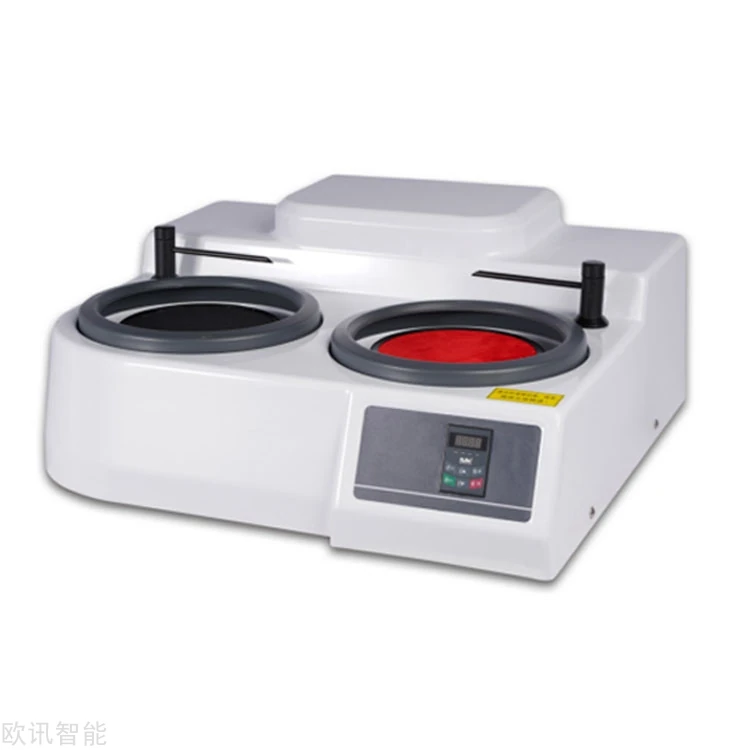
1. Structure and Operating Principle
1.1 Mechanical system
Platen: a motor-driven polishing platen (single or twin disc) with adjustable speed, typically 50–600 rpm, and forward / reverse switching.
Pressure control: manual or automatic pressure application, set by weights or a pneumatic system to control the force between specimen and polishing cloth (0–50 N).
Specimen holder: a holder that secures several specimens at once; some models support fully automatic specimen loading.
1.2 Polishing media
Polishing cloth: napped, nylon or diamond cloths selected according to material hardness.
Suspension / lubricant: abrasives containing diamond, alumina or silica particles, in grades from coarse to fine (e.g. 9 μm down to 0.02 μm).
1.3 Auxiliary functions
Cooling system: prevents overheating during polishing, which would otherwise alter the specimen microstructure.
Dust extraction: reduces polishing dust contamination and keeps the working environment clean.
2. Core Application Areas
2.1 Metallic material analysis
Steels and alloys: preparation of metallographic specimens for observing grain structure and inclusion distribution.
Non-ferrous metals: microstructure and phase analysis of aluminium, copper and their alloys.
2.2 Ceramics and hard materials
Surface polishing of ultra-hard materials such as tungsten carbide and silicon nitride, for the inspection of porosity and cracking.
2.3 Electronics and semiconductors
Cross-section polishing of chip packaging materials and solder joints, producing clearly visible interfaces.
2.4 Failure analysis
Polishing of fracture surfaces on mechanical parts for the analysis of fatigue cracks or corrosion damage.
3. Technical Features
3.1 High-precision control
Precise control of speed and pressure avoids over- or under-polishing.
Multi-stage polishing programmes (rough → fine → final) progressively remove surface defects.
3.2 Automation and intelligence
Fully automatic machines run preset programmes that reduce operator error.
Some models are fitted with sensors that monitor the polishing state in real time and adjust the parameters accordingly.
3.3 Compatibility
Works with a wide range of consumables, including cloths of different hardness and various abrasives.
Accepts specimens of different sizes, typically Ø25 mm to Ø50 mm.
4. Operating Procedure and Precautions
4.1 Typical polishing steps
Rough polishing: a coarse diamond suspension (e.g. 9 μm) removes cutting marks quickly.
Fine polishing: a fine alumina grade (1 μm) further smooths the surface.
Final polishing: colloidal silica (0.02 μm) produces a mirror finish.
4.2 Key parameters
Speed: higher speeds (300–600 rpm) for rough polishing, reduced to 100–200 rpm for fine polishing.
Pressure: harder materials require higher pressure; brittle materials need low pressure to avoid cracking.
4.3 Maintenance
Clean residual abrasive from the platen and cloths regularly to prevent cross-contamination.
Check lubrication of the motor and drive components to ensure smooth running.
Store polishing suspensions sealed and away from light to prevent particle agglomeration.
Interested in this equipment?
Tell us your testing needs — we will tailor a solution for you
Email Inquiry