
How to choose a valve flow-coefficient test bench: parameters to confirm before purchase
Before purchasing a valve flow-coefficient test bench, confirm the product under test, medium, flow and differential-pressure ranges, temperature conditions, measurement requirements, piping layout and acceptance method. Obtaining stable, verifiable data under specified conditions matters more than comparing maximum flow, maximum pressure or the accuracy of a single sensor.
1. Define the objective: flow capacity or regulating performance?
A flow coefficient characterises a valve’s flow capacity under defined conditions. Kv and Cv use different units and reference conditions: Kv normally refers to water flow in m³/h with a reference differential pressure of 1 bar; Cv normally uses US gallons per minute with a reference differential pressure of 1 psi. Do not mix the two. Reports should state the coefficient definition, units and calculation basis. [1]
These reference conditions do not mean that every product must be tested directly at 1 bar or 1 psi. Actual differential pressure, temperature, flow regime and calculation corrections must follow the applicable test method. Simplified calculations for ordinary water cannot be applied directly to gases or special liquids.
Distinguish four objectives before purchase: the fully open flow coefficient, characteristic curves at different openings or scale settings, differential-pressure behaviour at different flows, and regulation performance of balancing or differential-pressure regulating valves. Each objective may require different controls, measurement configurations and software.
2. Product specifications and connections: specify more than a DN range
Provide the valve type, nominal size, connection type, connection length, flow direction and mounting orientation. Threaded, flanged and other connections need matching adapters. Changing between sizes also involves fixture quantities, changeover time and positioning.
For tests at different openings, define how the opening is set and recorded, such as a manual scale, mechanical stroke or actuator control. For multiport products, specify the test flow path and the condition of the remaining ports. Sample drawings and actual samples usually clarify the proposal better than a list of nominal sizes alone.
3. Flow and differential pressure: focus on the usable measurement range
The range must cover the expected minimum and maximum flows, not merely the highest flow the machine can produce. Confirm the flowmeter’s capability at low flows. A broad range may require multiple measurement ranges or switchable circuits.
Specify system operating pressure, upstream pressure, downstream pressure and differential pressure across the valve separately. Maximum system pressure and differential-pressure measurement range are different specifications.
For high-flow, low-differential-pressure conditions, check the differential-pressure range and measurement requirements carefully. If differential pressure is obtained by subtracting two pressure readings, evaluate the effect of measurement errors on the small difference. Decide whether a dedicated differential-pressure sensor is needed for the actual range.
Flow, pressure and temperature may constrain one another. Ask the supplier to state the operating points that must be achieved simultaneously; individual maximum ratings should not be assumed to be available together.
4. Medium and temperature: maintain comparable test conditions
Specify water, a defined coolant or another medium, and confirm compatibility of wetted materials, seals, pumps and instruments. A change of medium requires reconsideration of density, viscosity and calculation methods.
Temperature requirements include not only limits but also permissible fluctuations during testing, measurement location and criteria for a stable condition. Extended operation of a recirculating system can cause temperature rise. Confirm any cooling, heating, filtration and air-removal requirements in the proposal.
For liquid-cooling valves, distinguish flow-coefficient testing, pressure-drop assessment with a specified coolant and sealing tests. They may share parts of the circuit, but a flow-test configuration should not be assumed to cover every test.
5. Measurement and piping: sensor accuracy is not result accuracy
The accuracy specification of one instrument does not directly represent the accuracy of a flow-coefficient result. Flow and differential-pressure measurements, temperature, installation layout, data processing and operating stability all affect the result.
The technical agreement should state how accuracy is expressed, for example as a percentage of reading or full scale, together with the applicable range, calibration requirements, repeatability and, where needed, measurement uncertainty evaluation. Display resolution must not be treated as measurement accuracy.
Select test-section size, straight pipe lengths, pressure-tapping positions, connections and reducers according to the chosen method. Check that the equipment has enough space for the required test-section layout.
IEC 60534-2-3 applies to industrial process control valves and includes test procedures related to flow capacity. Select the applicable standard and edition for the valve type and customer requirements; no single standard should be assumed to apply to all valves. [2]
6. Software and reports: make results traceable
Confirm whether the software records sample identification, model, opening or scale setting, medium, temperature, flow, upstream and downstream pressures, differential pressure and calculated results. Specify the sampling interval, stability criteria, data-selection interval and averaging method for the test.
For characteristic curves, define axes, units, test points and raw-data storage. Reports should state the test conditions and calculation basis rather than providing only a coefficient that cannot be verified.
Automatic pass/fail decisions require explicit limits and rules. Agree data-export formats, report templates, backups and operating permissions as part of the equipment proposal.
7. Acceptance and maintenance: put agreed requirements in writing
Before purchase, select representative samples covering key sizes, flow ranges and differential-pressure conditions. Agree procedures, stability conditions, repetitions and acceptance requirements. When comparing against reference samples, define the source of reference values and the test conditions.
Acceptance should cover fixture compatibility, data and report output, repeatability, instrument calibration documentation and achievement of agreed operating points as well as a functional demonstration. Confirm protective functions appropriate to operating conditions, such as overpressure, low water level, abnormal temperature and emergency stops.
Discuss calibration intervals, filtration and cleaning, consumable replacement, software maintenance and service arrangements in advance. Clear delivery and acceptance requirements help reduce later misunderstandings.
Purchasing parameter checklist
| Category | Items to confirm |
|---|---|
| Product and connections | Type, size, flow direction, connections, opening settings and fixture changeover |
| Test items | Fully open coefficient, opening curves, flow–differential-pressure curves and regulation performance |
| Flow | Minimum and maximum flow, key operating points and multiple-range measurement needs |
| Pressure and differential pressure | System, upstream and downstream pressures, differential-pressure range and stability conditions |
| Medium and temperature | Composition, material compatibility, temperature range and fluctuation, air removal and filtration |
| Measurement | Accuracy expression, range, calibration, repeatability and uncertainty requirements |
| Piping | Test section, straight lengths, pressure taps, connections and reducers |
| Data and reports | Sample information, raw data, curves, calculation basis and export formats |
| Acceptance and maintenance | Representative samples, acceptance conditions, decision methods, calibration and service |
Ouxun water flow test benches: discuss configuration against your product requirements
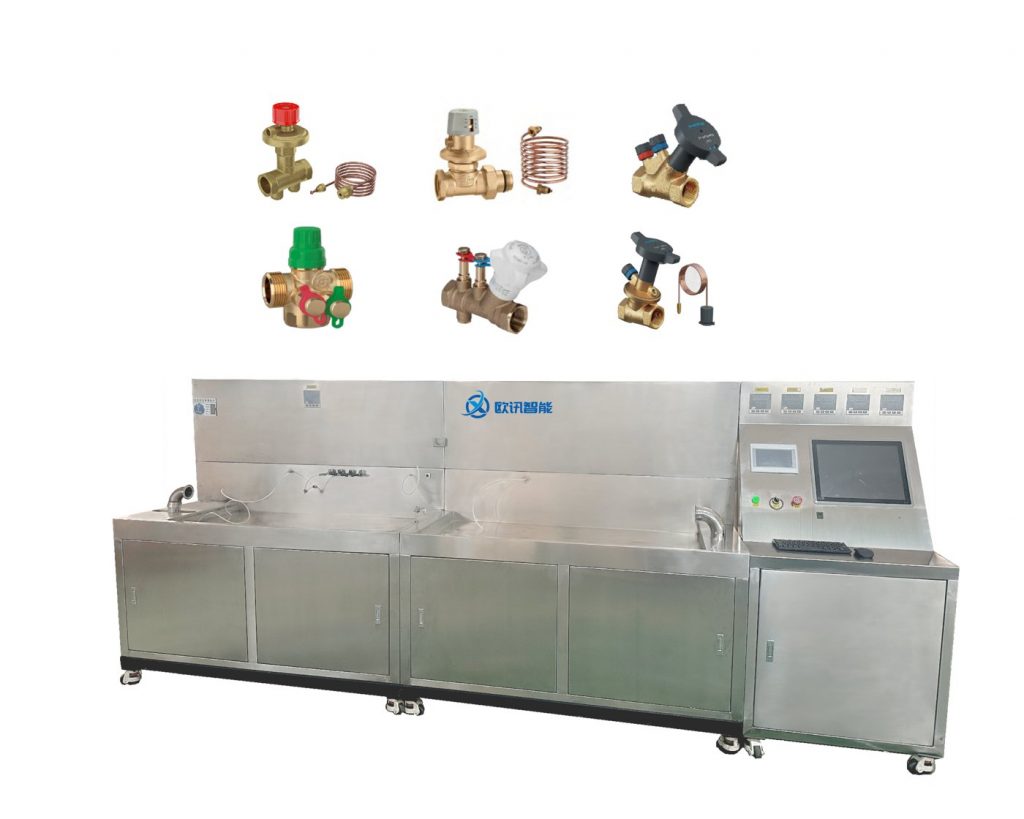
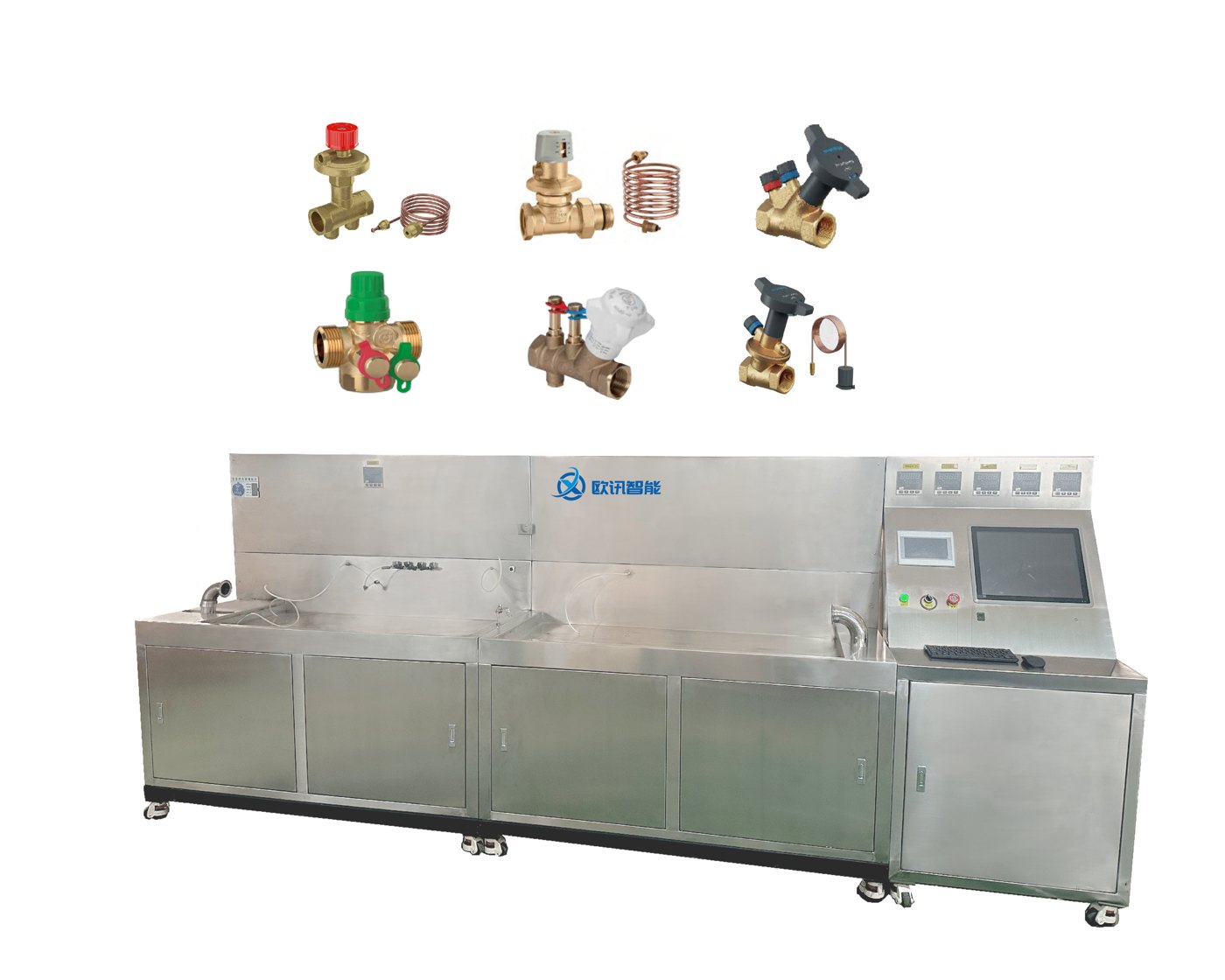
According to the Ouxun Intelligent Technology (Taizhou) Co., Ltd. website, its water flow test bench, also described as a valve flow-capacity test bench, is intended for water valves, static and dynamic balancing valves and differential-pressure regulating valves. Listed items include flow coefficients, balancing-valve coefficients at different scale settings, operating and control differential-pressure performance, and dynamic regulation of dynamic balancing valves. [3]
Listed components include pressure sensors, differential-pressure sensors, pressure-stabilising tanks, flowmeters, industrial computers, display instruments and variable-frequency drives. Test specifications can be customised. Confirm ranges, accuracy, functions and deliverables using samples and requirements, then record them in the technical proposal. [3]
Prospective buyers can prepare drawings, samples, test items and operating-condition lists to discuss configuration with Ouxun. Website: www.ouxunzn.com; telephone: 15325592373 (also on WeChat), 13967621080.
Frequently asked questions
Is a bench with a higher maximum flow always better? First consider the actual measurement range. The equipment must cover the maximum demand while meeting measurement requirements at the minimum flow and key operating points.
Can a flow-coefficient bench replace air-tightness or pressure-resistance test equipment? The name alone cannot establish this. Different tests need appropriate circuits, instruments, fixtures, controls and decision methods. Confirm each test separately.
What is the minimum information needed before purchase? Provide samples or drawings, specifications and connections, medium, target test items, flow and differential-pressure ranges, applicable specifications and acceptance requirements.
References
[1] Emerson: Flow converter (Kv and Cv definitions and units)
[2] IEC: IEC 60534-2-3:2015 (scope and overview of test procedures)