
Metallographic Pre-Grinding Machine
Metallographic Pre-Grinding Machine
For sectioned or mounted metallographic specimens, to remove cutting marks and uneven areas before fine grinding, polishing and microstructure observation. Circuits and fixtures are selected for the sample and required tests.
Product Overview
Application and test scope
Metallographic Pre-Grinding Machine is intended for sectioned or mounted metallographic specimens. It is used to remove cutting marks and uneven areas before fine grinding, polishing and microstructure observation. The test arrangement is selected around the sample construction, service conditions and required evaluation method.
Tests and configuration
- Abrasive-grade selection for the material and initial surface
- Progressive surface refinement using abrasive papers or discs
- Cooling and cleaning during specimen preparation
Typical test workflow
Start with an abrasive grade suited to the initial surface, refine progressively and check that the previous scratches have been removed. Control grinding conditions for the material, clean the specimen and proceed to polishing.
Selection information
For a suitable proposal, provide specimen material and size, initial surface, grinding-platen configuration, holding method, cooling conditions and subsequent preparation steps. Product drawings or a sample help define connections, locating tooling and test circuits.
Measurement ranges, accuracy, automation, data interfaces and acceptance criteria are defined by the selected configuration and agreed technical proposal.
Existing equipment information
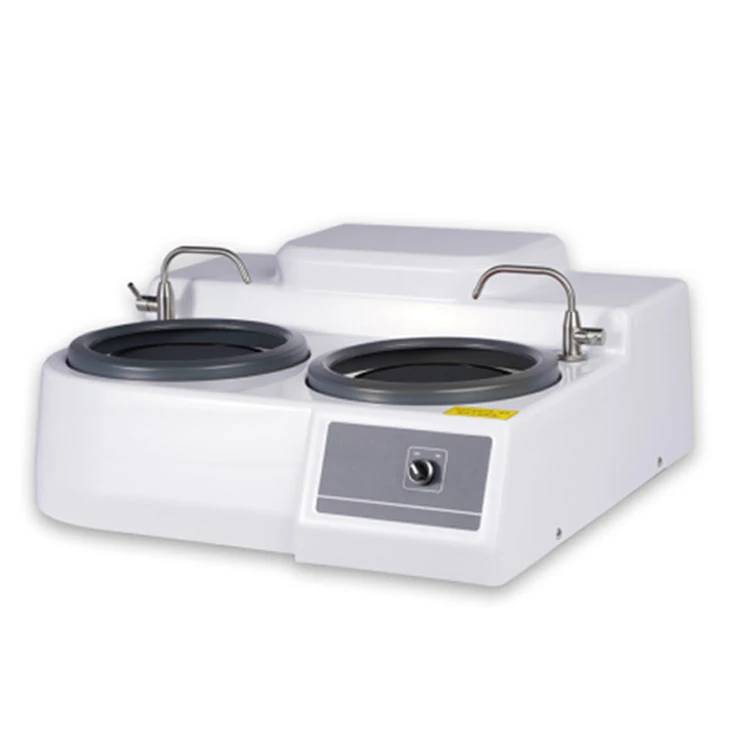
1. Structure and Operating Principle
1.1 Mechanical system
Grinding disc: a motor-driven metal or composite disc onto which abrasive papers or diamond grinding discs of various grits are fixed, commonly P80–P2000.
Specimen holder: manual or automatic clamping that secures the specimen and applies a controlled force, typically 5–30 N, to ensure uniform grinding.
Cooling system: a water flow or spray prevents overheating that would alter the material structure, such as tempering of metals.
1.2 Control system
Speed control: multiple speeds, e.g. 50–300 rpm — higher speeds raise efficiency during rough grinding while lower speeds reduce damage during fine grinding.
Pressure adjustment: a mechanical lever or pneumatic device controls the contact force between specimen and disc to suit materials of different hardness.
1.3 Auxiliary functions
Dust extraction / drainage: collects grinding swarf and coolant to keep the working area clean.
Automatic reversal: some models support forward / reverse switching of the disc, avoiding the directional texture bias caused by one-way grinding.
2. Core Application Areas
2.1 Metallic specimen preparation
Steels and alloys: removes the oxide layer and burrs left by cutting, exposing a uniform microstructure.
Non-ferrous metals: rough grinding of aluminium and copper without excessive deformation of these soft metals.
2.2 Hard material processing
Ceramics and cemented carbides: diamond discs grind high-hardness samples with reduced edge chipping.
2.3 Composites and coatings
Cross-section preparation of layered structures such as thermal barrier coatings, keeping every interface clearly defined.
2.4 Failure analysis and industrial quality inspection
Initial preparation of fracture surfaces on mechanical parts, allowing subsequent observation of crack initiation and propagation paths.
3. Technical Features
3.1 Efficient staged grinding
Supports staged grit changes, e.g. P120 → P400 → P800, to refine the surface progressively.
Removes cutting marks quickly, shortening overall specimen preparation time.
3.2 Precise control
Adjustable speed and pressure suit brittle materials such as cast iron as well as ductile ones such as titanium alloys.
Some models feature a digital display for real-time monitoring of grinding parameters.
3.3 Compatibility and expandability
Works with various abrasives: abrasive papers, diamond discs and resin-bonded discs.
Accepts different specimen sizes — standard Ø30 mm, or custom fixtures.
3.4 Durability
The disc is made of stainless steel or high-strength composite, resisting corrosion and wear.
Sealed bearings reduce dust ingress and extend service life.
4. Operating Procedure and Precautions
4.1 Typical pre-grinding steps
Rough grinding: low-grit papers (P120–P240) remove cutting marks quickly.
Intermediate grinding: medium-grit papers (P400–P600) level the surface.
Fine grinding: high-grit papers (P800–P1200) refine the surface further, approaching the finish required before polishing.
4.2 Key operating parameters
Speed: 200–300 rpm recommended for rough grinding, reduced to 100–150 rpm for fine grinding.
Force: 20–30 N for hard materials; 5–10 N for soft materials to avoid deformation.
Grinding direction: rotate the specimen 90° each time the paper is changed, so that removal of the previous scratches is easy to verify.
4.3 Maintenance
Clean residual abrasive from the disc regularly to prevent cross-contamination.
Check the flatness of papers or discs and replace worn parts promptly.
Filter or replace the coolant periodically to prevent debris affecting grinding quality.
Interested in this equipment?
Tell us your testing needs — we will tailor a solution for you
Email Inquiry