

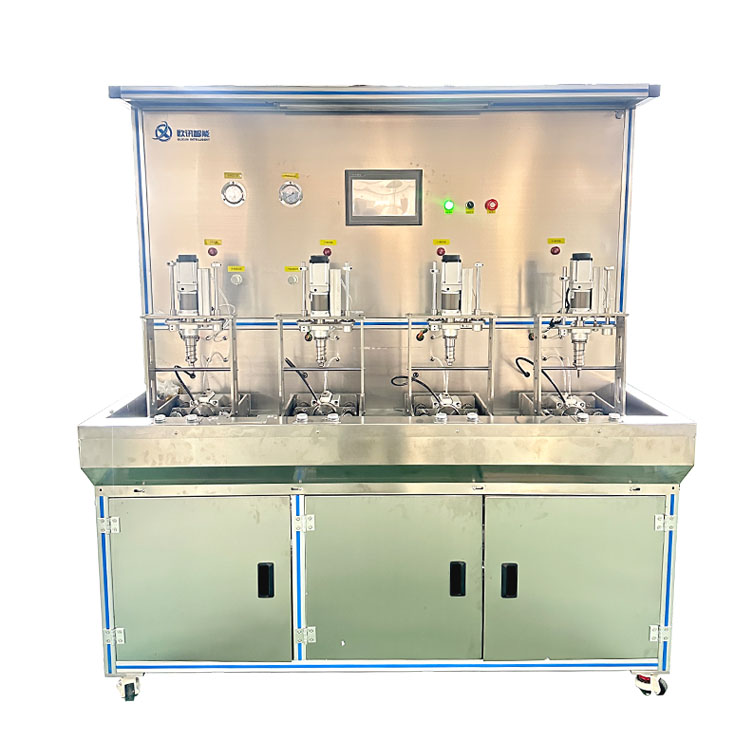
The frustrating part of air-tightness testing is not failing to detect a leak. It is testing the same valve twice and getting two different answers. Before blaming the valve, work through the list below in order.
Five leak sources that cause bad calls
- Fixture face. A seal of the wrong section, hardness or compression lets gas escape around the valve, and that leak gets recorded as a seat leak. Seal compression typically runs 20 to 30 percent of cord diameter; over-compressed seals contact unevenly, under-compressed ones simply leak. Both look identical on the pressure curve and can only be separated by inspection.
- Fittings and hose. Quick couplings, threaded joints and kinked hose are the most overlooked leak paths. Poor tape application or a fitting short of torque can leak at the 0.1 mL/min level – right at the pass limit.
- Insufficient stabilisation. Compressed gas heats up and then cools, so pressure falls on its own. That fall and a real leak look the same on a single trace. A differential test – a known-good sample in parallel with the part under test – separates thermal drift from leakage within a minute.
- Wrong valve position. Seat tightness, stem packing and shell are tested at different positions and with pressure applied from different directions. A ball valve tested for shell at full open and for seat at half open will not leak where the operator thinks it leaks.
- Oversized transducer. Reading a small decay with a high-range sensor gives resolution too coarse to decide anything. Size the transducer at 1.5 to 2 times the test pressure, not the bench maximum: a 40 MPa sensor on a 0.6 MPa air test drowns the decay signal in noise.
A troubleshooting order that works
Verify the bench first with blind plugs and a calibrated leak orifice, then blank-fixture pressure hold. Only after the blank fixture passes should a sample go in. Record pressurisation curve, stabilisation time, test pressure and the decay or flow value. If only one fixture face misbehaves, check face parallelism and the seal. If every sample misbehaves, look at air dryness, the regulator and sensor zero.
Do not skip the leak orifice. A calibrated 10 mL/h orifice checked at the start of each shift keeps “is it the bench or the valve” out of the discussion entirely. The five common leak-test methods – pressure decay, flow, bubble immersion, helium and differential – have different floors and different costs, and choosing the right method matters more than tightening the pass criterion: pick the wrong method and no criterion will be measurable.
Shell strength and higher pressure ratings are normally covered by hydrostatic testing. Where air is used to find small leaks, guarding, vent paths and the allowable leak value belong in the work instruction. The allowable value follows the seat type: soft-seated valves are usually Class A, metal-seated valves relaxed by size, and the ISO 5208 leak rates can be copied straight into the instruction. Class alone is not enough either – hold time is banded by size, and too short a hold lets a small leak stay invisible.
If only one line is remembered, make it this: prove the bench is good before suspecting the valve. How bench capability maps to each test requirement is set out in the equipment selection guide.
Acceptance criteria for air tightness differ by standard. Leakage criteria and edition status across the four systems are laid out in the Valve Test Standards Index (GB/T, ISO, API, EN cross-reference).
Related test equipment
Each test above maps to a bench. Pick by valve type and by the item you need to prove:
- Pipe and connection leak test bench — pressure-decay and helium methods, judged against a leak-rate limit
- Valve pressure test machine — shell at 1.5x and seat at 1.1x, with a report per valve
- Valve torque test machine — break-to-open and seating torque curves for actuator sizing
- Valve testing equipment range — browse all models by valve type and test item