
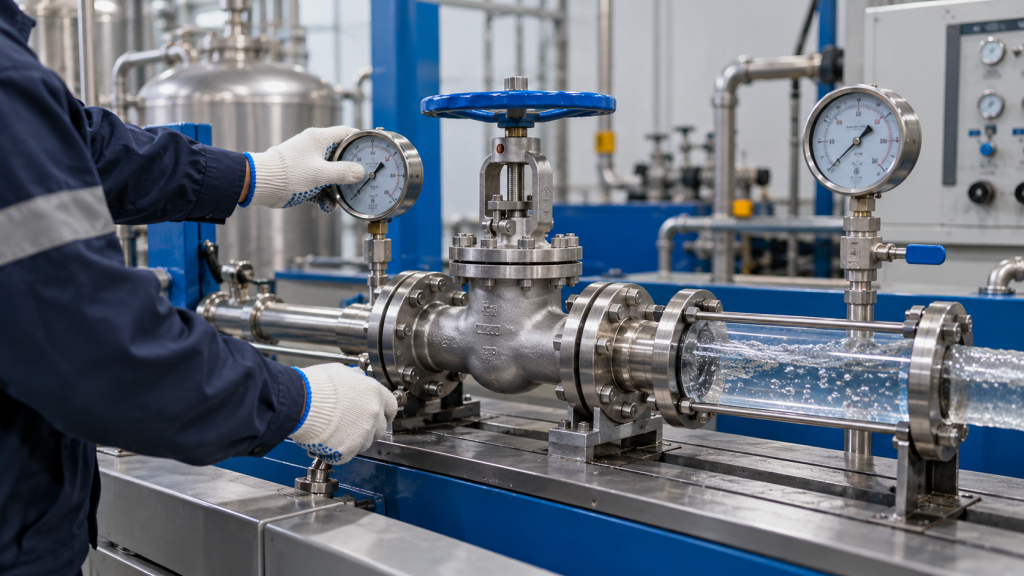
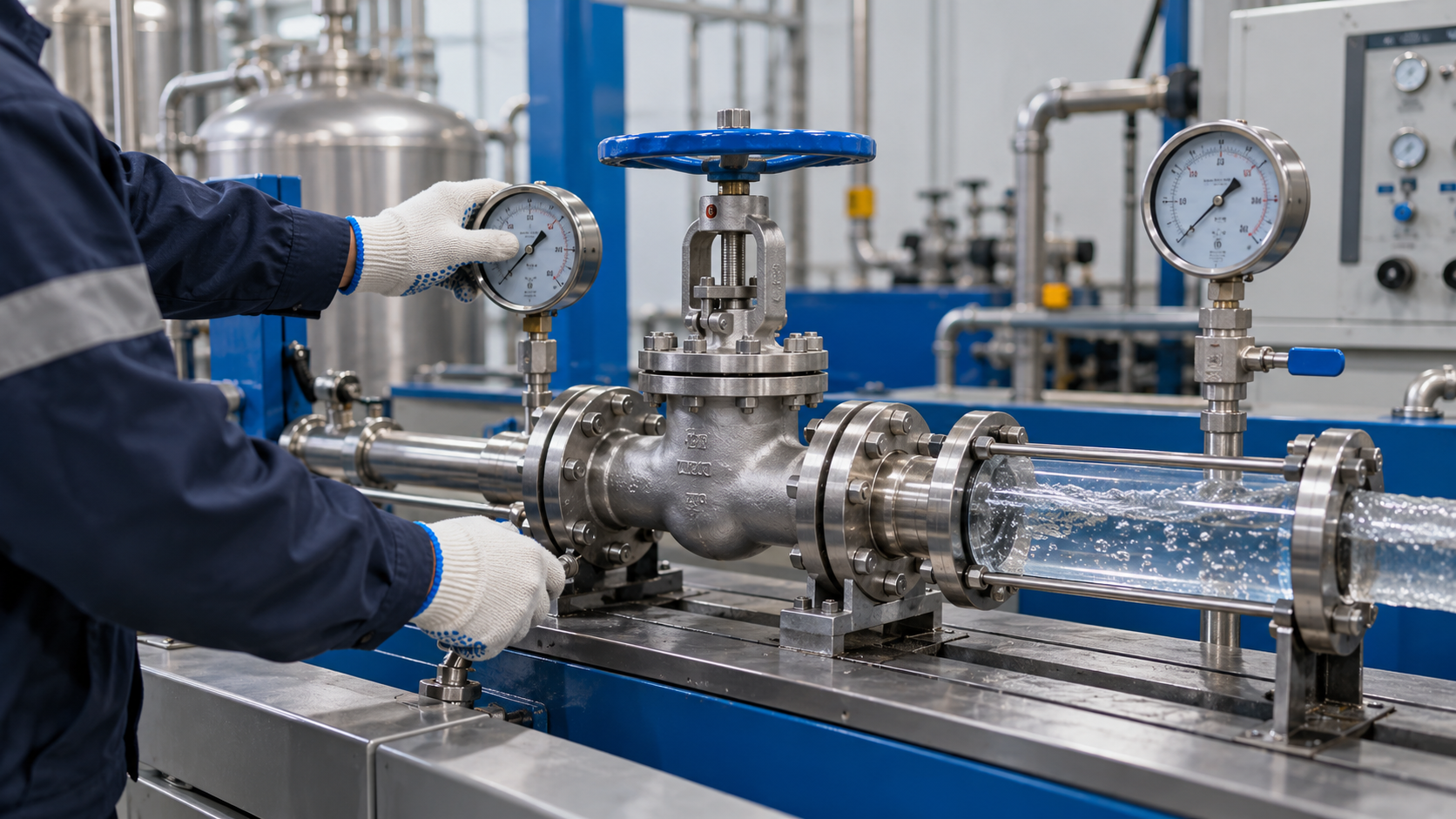
Most enquiries arrive as one line: “we need a valve test bench”. The argument starts at acceptance, when pressure will not hold, the fixtures do not fit, or nobody can reproduce a recorded result. Selection does not begin with price. It begins with writing down what is being tested and how pass or fail is decided.
Six things to fix before asking for a quote
- Valve type and size range. Ball, gate, globe, pressure-reducing and safety valves are clamped differently, and the DN range sets both fixture stroke and seal inventory. A requirement covering DN15 to DN300 is two fixture sets, not one, and seals have to be stocked by size – a bench with only the largest seal cannot start work on a small valve.
- Test medium. Hydrostatic testing covers shell strength and liquid seat tightness; air or nitrogen finds smaller leaks but stores far more energy, so guarding and venting belong in the specification. Pressure limits, hold times and isolation requirements for gas testing are set out in GB/T 13927-2022, and copying the clause into the specification saves the argument later.
- Pressure rating. Nominal pressure PN, actual test pressure, pressurisation rate and hold time are four separate numbers, not one “maximum pressure”. PN is the rating cast on the body; test pressure is derived from CWP or PN according to the standard, and mixing the two is the most common source of confusion at enquiry stage. How PN and CWP relate is worth settling before sizes are discussed – a photo of the body marking is more useful to a supplier than a verbal description.
- What is measured. Pressure decay, leak rate, set pressure, reseat pressure, operating torque – each decides which sensors and channels are needed. Leak class has to be chosen first: soft-seated valves are usually specified to Class A, metal-seated valves relaxed to C to E by size. The ten ISO 5208 classes give the allowable leak rate directly, and putting the class in the enquiry tells the supplier whether pressure decay or a flow method is required.
- Cycle time. Throughput, changeover time and whether one or two stations are needed drive pump, fixture and control configuration. Hold time dominates the cycle, and hold time is banded by size – work out the hold time for each size band before deciding whether a single station is enough.
- Record format. If results go to a MES or a shipping report, agree barcode, raw curves, pass/fail logic and export format at purchase. Retrofitting a data interface later usually costs more than specifying it up front.
The mistake that shows up at acceptance
Treating “pressure reached” as “test passed”. A pass also covers leak decision during the hold period, the record of test conditions, and what happens on an exception. A fixture designed only around the largest size lets small valves sit off-centre, compresses the seal unevenly, and the readings drift.
The second common gap is a specification where the test type and the acceptance rule do not match. Shell test looks at the body and body-bonnet joint; seat test looks at leakage across the seat. Allowable values, hold times and observation methods differ. Writing “per GB/T 13927” without class and medium leaves nothing to check against on the floor – the item-by-item checklist for writing these into a technical agreement is in the equipment selection guide.
At minimum the enquiry should state the valve list, DN/PN, medium, target pressure, hold time, allowable leak class, cycle time, record retention period and acceptance samples. Ouxun configures hydrostatic, air-tightness, flow or torque modules around the actual samples and takt time.
Related test equipment
Each test above maps to a bench. Pick by valve type and by the item you need to prove:
- Valve pressure test machine — shell at 1.5x and seat at 1.1x, with a report per valve
- Valve torque test machine — break-to-open and seating torque curves for actuator sizing
- Pipe and connection leak test bench — pressure-decay and helium methods, judged against a leak-rate limit
- Valve testing equipment range — browse all models by valve type and test item